
 by
by 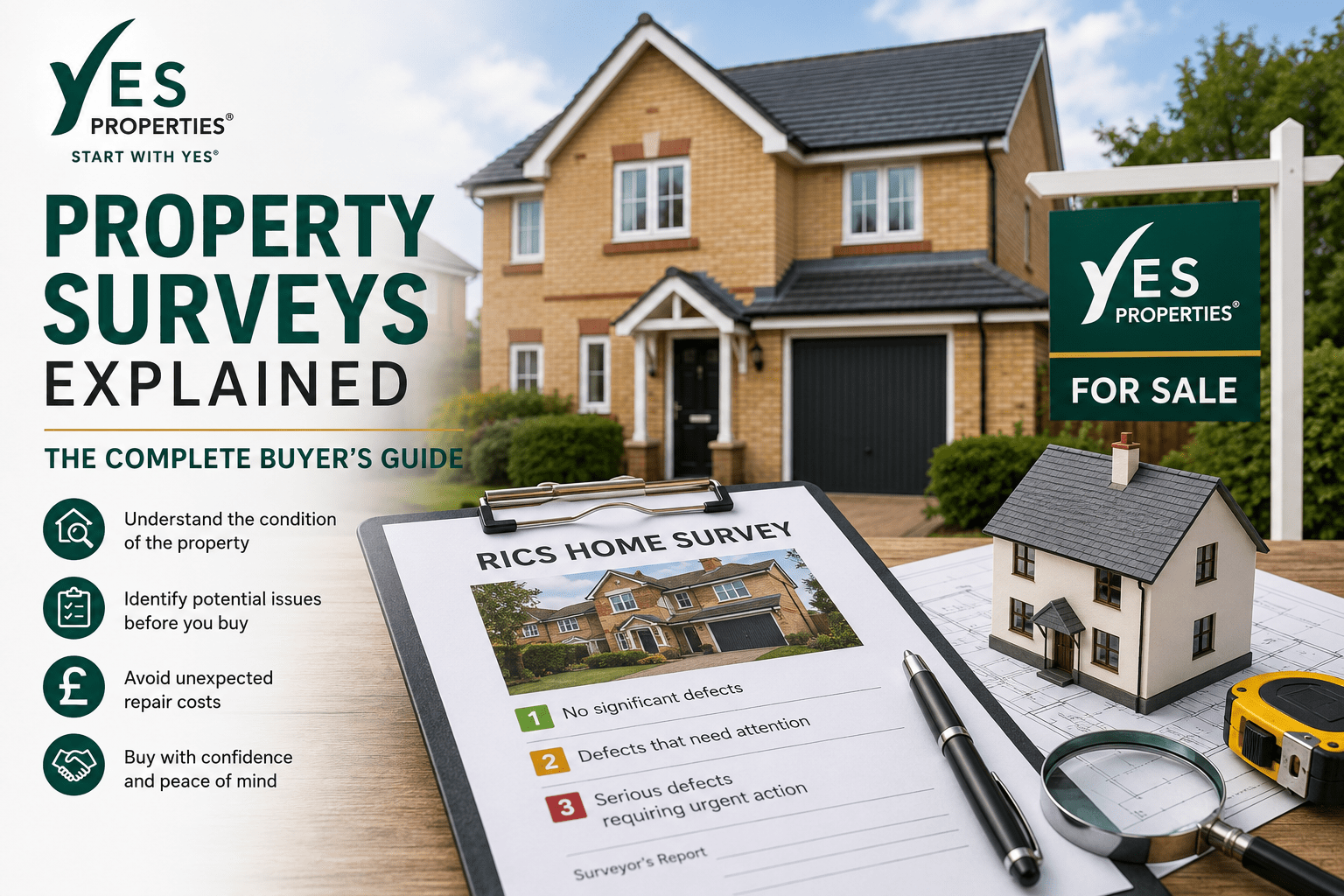
The Complete Buyer’s Guide | Yes Properties
Property Surveys Explained (2026) | Complete Buyer’s Guide | Yes Properties
Property Surveys Explained
Everything You Need to Know Before You Buy
Buying a property is one of the biggest financial commitments most people will ever make. While a home may appear perfect during a viewing, not every issue is immediately visible. Hidden defects such as damp, structural movement, roof problems or outdated electrics can result in unexpected repair costs after you move in.
A professional property survey provides an independent assessment of a property’s condition before you become legally committed to the purchase. It helps you understand the property’s overall state, highlights potential problems and allows you to make informed decisions before exchanging contracts.
Whether you’re purchasing your first flat, a Victorian family home or a new-build property, arranging the appropriate survey can provide valuable peace of mind and may even save you thousands of pounds.
At Yes Properties, we strongly encourage buyers to understand the different survey options available so they can choose the level of inspection that best suits the property they are purchasing.
What Is a Property Survey?
A property survey is an inspection carried out by a qualified surveyor to assess the condition of a property.
The surveyor examines various parts of the building and identifies:
- Visible defects
- Structural concerns
- Damp issues
- Roof condition
- Timber problems
- Drainage concerns
- Insulation issues
- General maintenance requirements
The findings are presented in a written report, helping you understand the property’s condition before completing your purchase.
Why Is a Property Survey Important?
A survey helps buyers:
- Identify hidden defects.
- Understand future maintenance costs.
- Avoid expensive surprises.
- Make informed purchasing decisions.
- Negotiate the purchase price where appropriate.
- Plan future repairs and improvements.
- Buy with greater confidence.
YES Expert Tip: Even a well-presented property can conceal costly issues. A fresh coat of paint may hide damp, while new flooring can sometimes conceal uneven floors or structural movement. A professional survey provides an independent assessment beyond what you can see during a viewing.
Is a Survey a Legal Requirement?
No.
There is no legal requirement to obtain a survey when buying a property.
However, choosing not to have one means you accept the risk of discovering defects after completion.
For most buyers, a survey is a sensible investment that provides reassurance and helps avoid unexpected costs.
Is a Mortgage Valuation the Same as a Survey?
No.
This is one of the most common misunderstandings among buyers.
A mortgage valuation is carried out for the lender, not for you.
Its primary purpose is to confirm that the property provides suitable security for the mortgage loan.
It is not a detailed inspection of the property’s condition.
If you want an assessment of the property’s condition, you should consider arranging an independent survey.
Who Carries Out Property Surveys?
Most residential property surveys are undertaken by qualified surveyors.
Many buyers choose a surveyor who is a member of the Royal Institution of Chartered Surveyors (RICS), as RICS members are required to meet recognised professional standards and follow established surveying guidance.
When selecting a surveyor, consider:
- Qualifications
- Experience
- Knowledge of local property types
- Experience with similar properties
- Clear reporting style
- Professional indemnity insurance
When Should You Arrange a Survey?
The best time to arrange a survey is after your offer has been accepted but before exchanging contracts.
This allows sufficient time to:
- Review the findings.
- Obtain specialist reports if necessary.
- Renegotiate the purchase price where appropriate.
- Decide whether to proceed.
Once contracts have been exchanged, you are generally legally committed to complete the purchase.
How Much Does a Property Survey Cost?
Survey costs vary depending on:
- Property value
- Property size
- Property age
- Survey type
- Location
- Surveyor
Although a survey represents an additional upfront cost, it can provide valuable information that may help you avoid significantly higher repair costs in the future.
Should Every Buyer Get a Survey?
In most cases, yes.
A survey is particularly worthwhile if the property is:
- Older.
- Extended.
- Listed.
- In need of renovation.
- Of unusual construction.
- A period property.
- A large family home.
Even newer properties can benefit from independent inspection, particularly if there are concerns about workmanship or finishes.
What Happens After the Survey?
Once the survey has been completed, you will receive a written report.
Depending on the findings, you may decide to:
- Proceed as planned.
- Request further specialist inspections.
- Renegotiate the purchase price.
- Ask the seller to remedy certain issues before completion.
- Withdraw from the purchase if serious problems are identified.
YES Expert Tip: Don’t panic if your survey identifies defects. Very few properties are completely free from issues. Focus on understanding the seriousness of the findings and seek professional advice where necessary.
Property Surveys Explained (2026)
Part 2 – Choosing the Right Property Survey
Not all property surveys provide the same level of inspection. The most suitable survey depends on the property’s age, condition, construction and your future plans for the home.
Choosing the right survey can help you identify hidden defects, understand future maintenance costs and make informed decisions before exchanging contracts.
Mortgage Valuation
A mortgage valuation is arranged by your lender to confirm that the property provides adequate security for the mortgage.
It is not a detailed inspection of the property’s condition.
The valuation is carried out for the lender’s benefit and may be very limited in scope. In some cases, it may even be completed without a physical internal inspection, depending on the lender’s process and the property.
A mortgage valuation will generally:
- Estimate the property’s market value.
- Confirm suitability for lending.
- Highlight significant concerns affecting mortgage security.
It will not normally:
- Identify all defects.
- Advise on future repairs.
- Provide detailed maintenance recommendations.
YES Expert Tip: Never rely solely on a mortgage valuation when buying a property. It is not designed to protect you as the buyer.
RICS Home Survey Level 1
The RICS Home Survey Level 1 is the most basic survey.
It is generally suitable for:
- Modern properties.
- Conventional construction.
- Homes that appear to be in good condition.
The report provides:
- A basic overview of the property’s condition.
- Identification of significant visible defects.
- Traffic-light condition ratings.
It does not include:
- Detailed repair advice.
- Market valuation (unless specifically requested).
- Extensive inspection of concealed areas.
RICS Home Survey Level 2
The RICS Home Survey Level 2 (previously known as the HomeBuyer’s Report) is one of the most popular choices for buyers.
It is suitable for:
- Conventional houses.
- Flats.
- Bungalows.
- Properties built after around 1900.
- Homes in reasonable condition.
The report includes:
- Visual inspection of the property.
- Condition ratings.
- Identification of significant defects.
- Damp observations.
- Roof inspection (where accessible).
- Timber concerns.
- Advice on repairs.
- Ongoing maintenance recommendations.
A market valuation and insurance reinstatement cost may also be included if requested.
For many buyers, Level 2 provides an excellent balance between detail and cost.
RICS Home Survey Level 3
The RICS Home Survey Level 3 (formerly known as a Building Survey) is the most comprehensive inspection available.
It is recommended for:
- Older properties.
- Victorian houses.
- Edwardian homes.
- Listed buildings.
- Thatched cottages.
- Timber-framed properties.
- Homes requiring renovation.
- Properties of unusual construction.
- Buildings that have been extensively altered.
A Level 3 survey provides:
- Detailed inspection.
- Structural observations.
- Construction analysis.
- Maintenance recommendations.
- Repair priorities.
- Discussion of likely causes of defects.
- Advice on future maintenance.
- Information about potential risks.
This survey is particularly valuable where significant investment or renovation is planned.
Snagging Survey (New Build Properties)
Many buyers assume a newly built property will be perfect.
Unfortunately, even new homes can contain defects.
A snagging survey identifies issues such as:
- Poor finishing.
- Paint defects.
- Uneven flooring.
- Cracked plaster.
- Poor brickwork.
- Missing insulation.
- Plumbing defects.
- Faulty windows.
- Doors requiring adjustment.
- Roofing defects.
Many developers will rectify genuine snagging items during the warranty period.
YES Expert Tip: A professional snagging survey can identify dozens of issues that buyers might easily overlook during a viewing.
Damp Survey
If signs of damp are identified during the main survey, a specialist damp inspection may be recommended.
This investigates:
- Rising damp.
- Penetrating damp.
- Condensation.
- Water ingress.
- Ventilation issues.
- Moisture levels.
Not every damp issue is serious, but understanding the cause is important before committing to the purchase.
Timber Survey
Where timber defects are suspected, a specialist timber inspection may be appropriate.
The survey may assess:
- Wet rot.
- Dry rot.
- Wood-boring insects.
- Structural timber.
- Roof timbers.
- Floor joists.
Early identification often helps prevent more extensive damage.
Structural Engineer’s Report
If a surveyor identifies possible structural movement or significant cracking, they may recommend an inspection by a structural engineer.
A structural engineer investigates issues such as:
- Subsidence.
- Settlement.
- Structural movement.
- Foundation concerns.
- Load-bearing walls.
- Structural alterations.
This provides a more detailed technical assessment than a standard property survey.
Electrical Inspection
Older electrical installations may require further investigation.
A qualified electrician can carry out an Electrical Installation Condition Report (EICR), assessing:
- Consumer unit.
- Wiring.
- Sockets.
- Earthing.
- Electrical safety.
This is particularly worthwhile for older properties or where the installation appears dated.
Gas Inspection
Where appropriate, a Gas Safe registered engineer can inspect:
- Boiler.
- Gas pipework.
- Gas appliances.
- Heating system.
Although sellers are not generally required to provide a gas safety certificate for owner-occupied homes, buyers may choose to arrange an inspection for peace of mind.
Drain Survey
Drainage problems are not always visible during a standard survey.
A CCTV drain survey can identify:
- Blockages.
- Cracked drains.
- Collapsed pipes.
- Root ingress.
- Drain misalignment.
This is often recommended if drainage problems are suspected.
Roof Survey
Roof repairs can be expensive.
If a survey identifies concerns, a roofing specialist may inspect:
- Roof coverings.
- Chimneys.
- Flashings.
- Gutters.
- Roof structure.
- Insulation.
- Ventilation.
Which Survey Should You Choose?
| Property Type | Recommended Survey |
|---|---|
| Modern flat | RICS Level 2 |
| Modern house | RICS Level 2 |
| Victorian house | RICS Level 3 |
| Edwardian house | RICS Level 3 |
| Listed building | RICS Level 3 |
| Property needing renovation | RICS Level 3 |
| New-build home | Snagging Survey (plus lender valuation where applicable) |
| Property with structural concerns | Structural Engineer’s Report (if recommended) |
Common Mistakes Buyers Make
Avoid these common mistakes:
❌ Assuming a mortgage valuation is a survey.
❌ Choosing the cheapest survey without considering the property’s age or condition.
❌ Ignoring recommendations for specialist inspections.
❌ Assuming new-build homes are defect-free.
❌ Delaying the survey until late in the transaction.
YES Expert Tip: The cost of the right survey is often small compared with the cost of repairing defects that could have been identified before you exchanged contracts.
Property Surveys Explained (2026)
Part 3 – Understanding Your Survey Report & Making the Right Decision
Receiving your survey report is an important milestone in the buying process. While it can sometimes appear technical or even alarming, it’s worth remembering that very few properties are completely free from defects. Even well-maintained homes will usually have items requiring repair, maintenance or monitoring.
The purpose of a survey is not to find a “perfect” property—it is to help you understand the property’s condition before you become legally committed to the purchase.
At Yes Properties, we encourage buyers to review their survey carefully, discuss any concerns with their surveyor and solicitor, and make informed decisions based on the findings.
Understanding RICS Condition Ratings
Most RICS Home Surveys use a simple traffic-light system to explain the seriousness of any issues identified.
Condition Rating 1 (Green)
No significant repair is currently needed.
The item appears to be in satisfactory condition, although normal maintenance will still be required over time.
Examples may include:
- Recently decorated walls
- Modern double glazing
- Good roof condition
- Well-maintained gutters
Condition Rating 2 (Amber)
The surveyor has identified defects that require attention but are not considered urgent.
These issues should be addressed in due course to prevent deterioration.
Examples include:
- Minor damp staining
- Worn pointing
- Ageing windows
- Guttering requiring repair
- Older electrics
Condition Rating 3 (Red)
The surveyor has identified a defect requiring urgent investigation, repair or replacement.
Further specialist advice may be recommended before proceeding.
Examples include:
- Structural movement
- Serious roof defects
- Significant damp
- Unsafe electrics
- Major timber decay
YES Expert Tip: A Condition Rating 3 does not automatically mean you should walk away. It simply means the issue should be investigated and understood before exchanging contracts.
Common Issues Found During Surveys
Many survey reports identify similar types of defects.
Some of the most common include:
- Damp
- Roof deterioration
- Blocked gutters
- Cracked render
- Timber decay
- Outdated electrics
- Plumbing defects
- Poor ventilation
- Insulation improvements
- General wear and tear
These findings are often expected, particularly in older properties.
Damp
Damp is one of the most common issues identified during surveys.
Possible causes include:
- Condensation
- Poor ventilation
- Rising damp
- Penetrating damp
- Leaking gutters
- Plumbing leaks
Not all damp problems are serious, but identifying the underlying cause is important before committing to the purchase.
Structural Movement & Subsidence
Small cracks are common in many properties and are not always a cause for concern.
However, significant movement may require further investigation.
Possible causes include:
- Subsidence
- Clay shrinkage
- Tree roots
- Settlement
- Historic movement
Where structural movement is suspected, the surveyor may recommend an inspection by a structural engineer.
Roof Defects
Roofs naturally deteriorate over time.
Surveyors commonly identify:
- Missing tiles
- Broken slates
- Worn flashing
- Damaged chimneys
- Blocked gutters
- Ageing roof coverings
Roof repairs can be expensive, so it is important to understand both the urgency and likely cost.
Electrical Installations
Many older homes contain electrical systems that no longer meet current standards.
The surveyor may recommend an Electrical Installation Condition Report (EICR) where the installation appears dated or concerns are identified.
Heating Systems
A surveyor will normally comment on the visible condition of the heating system but will not dismantle or test the boiler.
If concerns are identified, a specialist inspection by a Gas Safe registered engineer may be recommended.
Japanese Knotweed
Japanese Knotweed is an invasive plant that can affect property.
If it is identified or suspected, your surveyor will normally recommend specialist advice.
Some mortgage lenders have specific requirements where Japanese Knotweed is present.
Asbestos
Properties built before the year 2000 may contain asbestos-containing materials.
The surveyor will not normally confirm the presence of asbestos but may identify materials that warrant further investigation.
Where necessary, a specialist asbestos survey can be arranged.
Spray Foam Roof Insulation
Spray foam insulation has received increased attention in recent years because some lenders may have concerns about certain installations.
If spray foam insulation is present, your surveyor or lender may recommend further investigation before proceeding.
Timber Decay
Older properties sometimes suffer from:
- Wet rot
- Dry rot
- Woodworm
Where timber deterioration is suspected, a specialist timber survey may be appropriate.
Can You Renegotiate After a Survey?
Yes.
If the survey identifies significant defects that were not apparent when you made your offer, you may wish to discuss the findings with the seller.
Possible outcomes include:
- Proceeding at the agreed price.
- Renegotiating the purchase price.
- Asking the seller to carry out agreed repairs before completion.
- Agreeing a financial contribution towards future works.
Every situation is different, and any discussions should be based on reliable evidence and professional advice.
When Might It Be Sensible to Reconsider?
While many survey findings are manageable, there may be occasions where a buyer decides not to proceed.
This could include situations where:
- Extensive structural repairs are required.
- The cost of repairs is significantly higher than expected.
- The property no longer represents value for money.
- The risks identified are beyond the buyer’s budget or appetite.
A survey provides information to support your decision—it does not make the decision for you.
Survey Buyer’s Checklist
Before exchanging contracts, make sure you have:
✓ Read the survey in full.
✓ Understood all Condition Rating 3 items.
✓ Asked your surveyor any questions you may have.
✓ Obtained specialist reports where recommended.
✓ Discussed significant findings with your solicitor.
✓ Considered future repair costs.
✓ Reviewed your budget.
✓ Confirmed you’re happy to proceed.
Frequently Asked Questions
Do all properties have defects?
Almost every property has some defects. The key question is whether they are minor maintenance issues or more significant concerns requiring further investigation or repair.
Should I buy a property with damp?
That depends on the cause, severity and cost of remediation. Damp is common in many properties and is not always a reason to withdraw from a purchase.
Can I renegotiate the purchase price after a survey?
Yes. If significant previously unknown defects are identified, you may choose to discuss the findings with the seller and explore whether a revised price or other solution is appropriate.
Is a Level 3 survey always necessary?
Not always. Many modern properties are well suited to a Level 2 survey. Older, altered or unusual properties are more likely to benefit from a Level 3 survey.
Should I skip the survey to save money?
In most cases, no. While a survey represents an upfront cost, it can identify issues that may be far more expensive to address after completion.
Common Mistakes Buyers Make
Avoid these common mistakes:
❌ Assuming a property is problem-free because it looks well presented.
❌ Ignoring Condition Rating 3 items.
❌ Failing to arrange recommended specialist inspections.
❌ Overreacting to normal age-related wear and tear.
❌ Exchanging contracts before understanding the survey findings.
YES Expert Tip: Surveys should be viewed as a valuable source of information rather than a list of reasons not to buy. Understanding the condition of a property allows you to plan ahead, budget appropriately and negotiate where necessary.
Why Choose Yes Properties?
Buying a property is about more than finding the right location—it is about understanding exactly what you are purchasing.
At Yes Properties, we guide buyers throughout every stage of the process by providing:
- Honest and practical advice.
- Local property expertise.
- Guidance on surveys and inspections.
- Skilled negotiation.
- Sales progression support.
- Clear communication from offer through to completion.
Whether you’re purchasing a first home, a period property or an investment, we’re here to help you buy with confidence.
START WITH YES®
Looking to buy your next home?
Visit us:
Yes Properties
15 Morden Court Parade
London Road
Morden
SM4 5HJ
📞 Telephone: 0208 191 3717
✉️ Email: info@yesproperties.co.uk
Professional. Transparent. Local.
START WITH YES®
Related Guides
Continue your buying journey with:
- Complete First Time Buyer’s Guide
- Buying Leasehold Property
- Buying Freehold Property
- Mortgage Agreement in Principle Explained
- Hidden Costs of Buying Property
- How Much Deposit Do I Need?
- Stamp Duty Guide
- What Is Exchange of Contracts?
- Completion Day Explained
- Buying a Probate Property
Conclusion
A professional property survey is one of the most valuable investments you can make during the home-buying process. It provides an independent assessment of a property’s condition, highlights potential issues and equips you with the information needed to make confident, informed decisions.
Most properties will have some defects, particularly older homes, but understanding those issues before exchange allows you to budget, negotiate and plan appropriately.
At Yes Properties, we encourage every buyer to choose the survey that best suits the property they’re purchasing and to take the time to understand the findings before committing. With the right advice and preparation, you can move forward with confidence and enjoy your new home knowing you’ve made an informed decision.
START WITH YES®