
 by
by 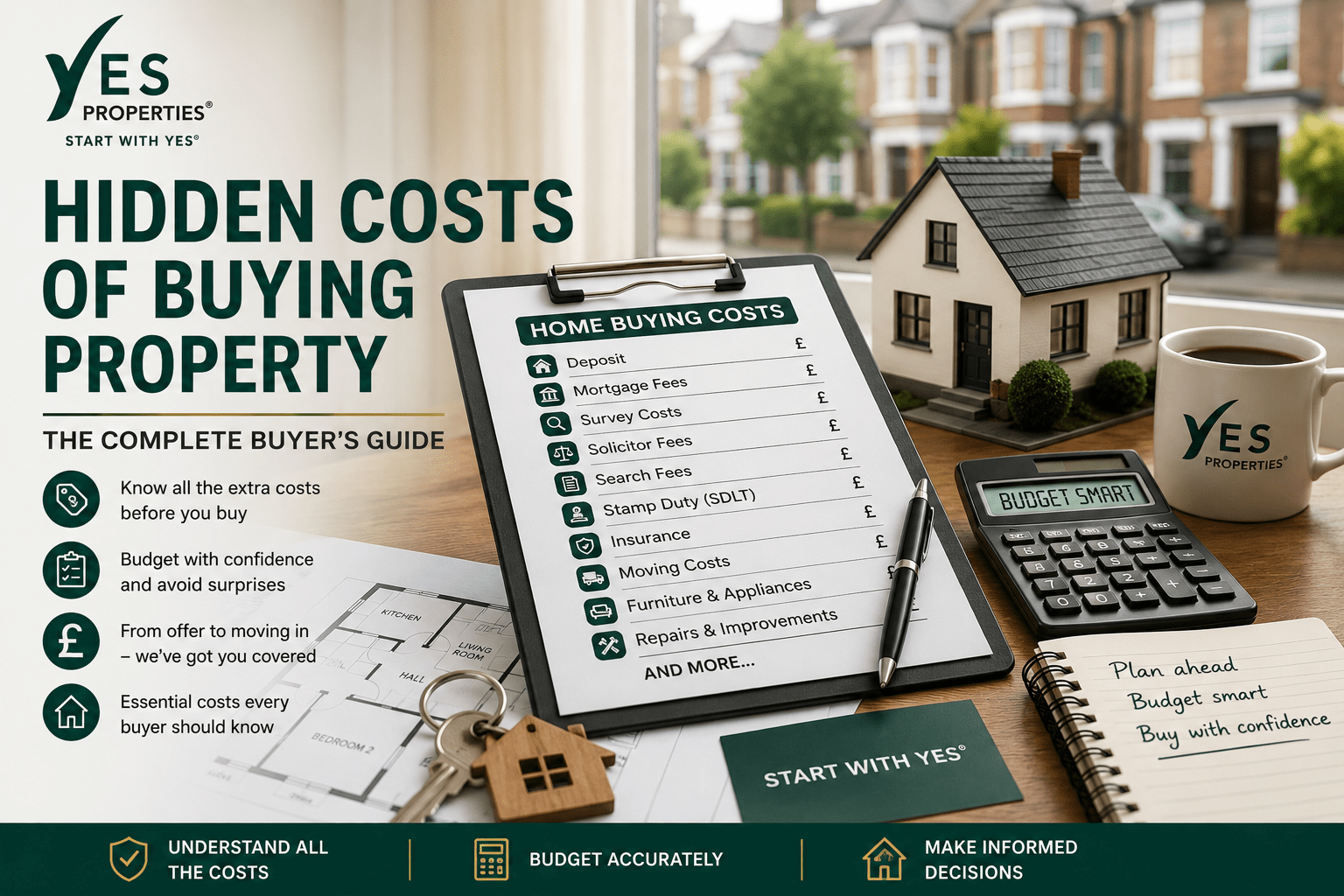
The Complete Buyer’s Guide | Yes Properties
Hidden Costs of Buying Property (2026) | Complete Buyer’s Guide | Yes Properties
Hidden Costs of Buying Property
Everything You Need to Know Before You Buy
When budgeting for a property purchase, many buyers focus on just two figures: the purchase price and the deposit. However, buying a home involves a range of additional costs that can add up to several thousand pounds.
Some expenses arise before you exchange contracts, others become payable on completion, and some only become apparent after you’ve moved into your new home. Understanding these costs from the outset will help you budget more accurately, reduce financial stress and avoid unexpected surprises.
At Yes Properties, we believe buyers should understand the full financial picture before making an offer. This guide explains the most common costs associated with buying a property in England, helping you prepare with confidence.
Why Budgeting Matters
Buying a property is one of the largest financial commitments most people will ever make. Failing to account for the additional costs can place unnecessary pressure on your finances, particularly during the final stages of the transaction.
Creating a realistic budget before you begin your property search allows you to:
- Understand the true cost of buying.
- Avoid overstretching your finances.
- Plan for moving expenses.
- Reduce the risk of unexpected costs.
- Buy with greater confidence.
YES Expert Tip: It’s sensible to keep some savings aside after completion for unexpected repairs, decorating or essential purchases rather than spending every penny on the purchase itself.
Your Deposit
For most buyers, the deposit is the largest upfront cost.
The amount required depends on:
- The purchase price.
- The mortgage lender’s requirements.
- Your personal financial circumstances.
A larger deposit may give you access to a wider choice of mortgage products and potentially more competitive interest rates.
Remember that your deposit is only one part of the overall cost of buying a property.
Mortgage Broker Fees
If you use a mortgage broker, they may charge a fee for arranging your mortgage.
Fee structures vary and may include:
- A fixed fee.
- A percentage of the loan.
- No direct fee, where the broker is paid by the lender.
Always ask how your broker is paid before proceeding.
Mortgage Arrangement Fees
Some mortgage products include an arrangement or product fee charged by the lender.
Depending on the mortgage, this fee may be:
- Paid upfront.
- Added to the mortgage balance.
- Waived as part of a promotional product.
When comparing mortgages, consider both the interest rate and any associated fees.
Mortgage Valuation Fee
Your lender may require a valuation of the property before issuing a formal mortgage offer.
Some lenders include this free of charge, while others may charge a fee depending on the product and property.
Remember that a mortgage valuation is carried out for the lender’s benefit and is not a substitute for an independent property survey.
Property Survey Costs
Many buyers choose to arrange an independent survey to better understand the condition of the property.
The cost will vary depending on factors such as:
- Property size.
- Property age.
- Survey type.
- Location.
Choosing the right survey can help identify defects before you become legally committed to the purchase.
For more information, see our Property Surveys Explained guide.
Conveyancing Solicitor Fees
Your conveyancing solicitor is responsible for handling the legal aspects of the purchase.
Typical work includes:
- Reviewing contracts.
- Conducting legal searches.
- Raising enquiries.
- Liaising with your lender.
- Registering ownership after completion.
Fees vary depending on the complexity of the transaction and the property involved.
Always request a clear quotation detailing both legal fees and any additional disbursements.
Local Authority Searches
Your solicitor will usually obtain several searches to investigate matters affecting the property.
These commonly include:
- Local Authority Search.
- Water and Drainage Search.
- Environmental Search.
Depending on the property’s location, additional searches may also be recommended, such as mining or flood risk searches.
These searches help identify potential issues before you complete your purchase.
HM Land Registry Fees
Following completion, your ownership must be registered with HM Land Registry.
Registration fees are payable according to the applicable fee scale and are usually handled by your conveyancing solicitor as part of the transaction.
Identity Verification (AML Checks)
Solicitors are legally required to carry out Anti-Money Laundering (AML) and identity verification checks.
These checks help prevent fraud and financial crime and may attract a modest administrative fee depending on the firm.
Typical checks include:
- Proof of identity.
- Proof of address.
- Source of funds verification.
- Source of wealth enquiries (where appropriate).
Bank Transfer (CHAPS) Fees
On completion, your solicitor will transfer large sums of money electronically.
Banks often charge fees for these secure transfers, sometimes referred to as CHAPS or same-day transfer fees.
You may see charges for:
- Sending your purchase funds.
- Redeeming mortgages (where applicable).
- Returning surplus funds after completion.
YES Expert Tip: Before instructing a solicitor, ask for a full written quotation that clearly separates legal fees from disbursements (payments made to third parties on your behalf). This makes it much easier to compare quotes and avoid unexpected costs later.
Hidden Costs of Buying Property (2026)
Part 2 – Costs to Budget for Before Completion
Once your offer has been accepted and the legal process is underway, several additional costs may arise before you collect the keys to your new home. Some of these costs are unavoidable, while others depend on the type of property you’re buying or your individual circumstances.
Understanding these expenses in advance will help you budget more accurately and reduce the likelihood of unexpected financial pressure as completion approaches.
Stamp Duty Land Tax (SDLT)
For many buyers, Stamp Duty Land Tax (SDLT) is one of the largest additional costs associated with purchasing a property in England.
The amount payable depends on factors such as:
- The purchase price.
- Whether you already own another property.
- Whether you’re eligible for any first-time buyer relief.
- The SDLT rates and thresholds in force at the time of completion.
Because SDLT rules can change, it’s important to check the current rates before committing to a purchase.
YES Expert Tip: Don’t leave Stamp Duty calculations until the last minute. Include it in your budget from the outset to avoid unpleasant surprises.
Buildings Insurance
If you’re buying a freehold property, you’ll normally need buildings insurance.
Buildings insurance typically covers:
- Fire
- Flood
- Storm damage
- Escape of water
- Subsidence (where included)
- Structural damage
If you’re buying with a mortgage, your lender will usually require buildings insurance to be in place before or on the date you become legally responsible for the property.
For many leasehold flats, the building is insured under a block policy arranged by the freeholder or management company, with the cost usually recovered through the service charge.
Contents Insurance
Buildings insurance protects the structure of the property.
Contents insurance protects your belongings, including:
- Furniture
- Electronics
- Clothing
- Appliances
- Personal possessions
Although not usually compulsory, contents insurance is often a sensible addition once you move into your new home.
Leasehold Notice Fees
If you’re purchasing a leasehold property, the lease may require formal notices to be served on the freeholder or management company after completion.
Common notices include:
- Notice of Transfer.
- Notice of Charge (where there is a mortgage).
Administration fees are often payable for registering these notices.
Deed of Covenant Fees
Some leasehold properties require the buyer to enter into a Deed of Covenant.
This is a legal agreement confirming that the new owner agrees to comply with the obligations contained within the lease.
The management company or freeholder may charge an administration fee for dealing with this process.
Certificate of Compliance Fees
Certain leasehold developments require a Certificate of Compliance before ownership can be registered at HM Land Registry.
This certificate confirms that the transfer complies with the requirements contained in the lease or title documents.
An administration fee may be payable to the relevant management company or freeholder.
Service Charge Apportionments
When buying a leasehold property, service charges are often apportioned between the seller and buyer on completion.
This ensures that each party pays their fair share for the period during which they own the property.
Your solicitor will calculate any necessary adjustments as part of the completion statement.
Ground Rent Apportionments
Where ground rent applies, it is also commonly apportioned between buyer and seller on completion.
Again, your conveyancer will calculate the appropriate adjustment based on the completion date.
Management Company Fees
Some developments charge administration fees for:
- Registering the new owner.
- Registering the mortgage lender.
- Providing management information.
- Updating their records.
These fees vary depending on the management company and the terms of the lease.
Indemnity Insurance Policies
Occasionally, an indemnity insurance policy may be recommended to address a legal issue affecting the property.
Examples include:
- Missing Building Regulations approval.
- Restrictive covenant issues.
- Lack of planning documentation.
- Missing easements.
- Chancel repair liability (where relevant).
These policies are often one-off payments made during the conveyancing process.
Gifted Deposit Costs
If part of your deposit is being provided by a family member or another third party, your solicitor and mortgage lender may require additional documentation.
This can include:
- Gifted deposit declarations.
- Identity verification.
- Source of funds checks.
- Anti-Money Laundering (AML) enquiries.
Some solicitors charge an additional fee for carrying out this extra legal work.
Mortgage Lender Fees
Depending on your mortgage product, you may encounter additional lender-related costs, such as:
- Product or arrangement fees.
- Booking fees.
- Telegraphic transfer fees.
- Mortgage account administration charges.
Some fees are payable upfront, while others may be added to the mortgage balance. Always review your mortgage illustration carefully so you understand the total cost of borrowing.
Lifetime ISA (LISA) Withdrawal
If you’re using a Lifetime ISA (LISA) towards your purchase, your conveyancer will normally arrange for the funds to be released.
While the withdrawal itself is not generally a hidden cost, buyers should allow sufficient time for the process and ensure the account meets the relevant conditions for a qualifying property purchase.
Searches for Specialist Risks
Depending on the property’s location, your solicitor may recommend additional searches beyond the standard package.
These could include:
- Flood risk searches.
- Mining searches.
- Ground stability reports.
- Chancel repair searches.
- HS2 or infrastructure searches (where relevant).
Each search may involve an additional fee but can provide valuable information before you commit to the purchase.
Completion Statement
Shortly before completion, your solicitor will issue a Completion Statement.
This document provides a detailed breakdown of all monies required to complete the purchase, including:
- Purchase price balance.
- SDLT (where applicable).
- Legal fees.
- Search fees.
- Land Registry fees.
- Bank transfer fees.
- Any apportionments.
- Any other agreed costs.
Review this carefully and ask your solicitor to explain anything you do not understand.
YES Expert Tip: Always check your Completion Statement several days before completion. This gives you time to raise any questions and arrange cleared funds without unnecessary last-minute pressure.
Common Mistakes Buyers Make
Avoid these common pitfalls:
❌ Budgeting only for the deposit.
❌ Forgetting about SDLT.
❌ Assuming solicitor’s quotations include every disbursement.
❌ Overlooking leasehold administration fees.
❌ Not reading the Completion Statement carefully.
❌ Leaving the transfer of funds until the last minute.
❌ Forgetting to arrange buildings insurance where required.
Hidden Costs of Buying Property (2026)
Part 3 – Costs After You Move In
Congratulations—you’ve completed your purchase and collected the keys to your new home. However, becoming a homeowner brings ongoing financial responsibilities that many buyers underestimate.
Planning for these costs from the outset will help you settle into your new home with confidence and avoid unnecessary financial pressure during your first year of ownership.
Removal Costs
Moving home is often more expensive than people expect.
Depending on the size of your move, you may need to budget for:
- Professional removal company
- Packing service
- Packing materials
- Storage facilities
- Van hire
- Cleaning services
- Parking permits (where required)
Obtaining several quotations before booking can help you compare services and costs.
Furniture & Appliances
Even if you’re moving from another property, you may need additional items such as:
- Beds
- Sofas
- Dining furniture
- Wardrobes
- White goods
- Curtains or blinds
- Garden furniture
- Lighting
These purchases can quickly add up, so it’s often sensible to prioritise essentials first.
Decorating & Improvements
Many buyers choose to decorate before moving in.
Common expenses include:
- Painting and decorating
- Flooring
- Carpets
- Curtains
- Blinds
- Internal doors
- Garden improvements
- Kitchen upgrades
- Bathroom improvements
Even relatively small cosmetic projects should be factored into your budget.
Utility Accounts
After completion, you’ll need to contact utility providers to open or transfer accounts.
These may include:
- Electricity
- Gas
- Water
- Broadband
- Telephone
- TV services
Take meter readings as soon as you receive the keys to ensure you’re only billed for your own usage.
Council Tax
Council Tax becomes your responsibility from the completion date (or from the date you become liable under the relevant rules).
The amount payable depends on:
- The property’s Council Tax band.
- Your local authority.
- Any discounts or exemptions that may apply.
Make sure you notify the local council promptly after moving in.
Broadband & Home Entertainment
Many buyers arrange:
- Fibre broadband
- Television packages
- Streaming services
- Home office connectivity
Installation times can vary, so it’s worth arranging these services before moving day if possible.
Security Improvements
Many homeowners choose to improve security shortly after moving in.
Typical upgrades include:
- Changing external door locks
- Smart locks
- Burglar alarms
- CCTV
- Video doorbells
- Security lighting
- Window locks
YES Expert Tip: Unless you know exactly who has keys to the property, consider changing the external locks soon after completion for additional peace of mind.
Home Maintenance
Owning a property means planning for routine maintenance.
Typical ongoing expenses include:
- Boiler servicing
- Gutter cleaning
- Roof inspections
- Exterior painting
- Window maintenance
- Garden maintenance
- Drain cleaning
- Pest control (where required)
Regular maintenance can help prevent more expensive repairs later.
Emergency Repair Fund
Unexpected repairs can arise at any time.
Examples include:
- Boiler breakdowns
- Plumbing leaks
- Roof damage
- Electrical faults
- Appliance failures
Many homeowners choose to keep an emergency fund specifically for unforeseen repairs.
Estate Management Charges
Some freehold developments include annual estate management charges covering communal facilities such as:
- Private roads
- Landscaping
- Children’s play areas
- Open spaces
- Lighting
- Drainage systems
Always understand these charges before purchasing.
Leasehold Ongoing Costs
If you’ve purchased a leasehold property, remember to budget for continuing obligations such as:
- Service charges
- Ground rent (where applicable)
- Reserve fund contributions
- Buildings insurance (usually included within the service charge)
- Future lease extension costs (if appropriate)
These should form part of your long-term budgeting.
Annual Home Budget
Many homeowners prepare an annual maintenance budget covering:
- Insurance renewals
- Boiler servicing
- Minor repairs
- Decorating
- Garden maintenance
- Appliance replacement
- Emergency repairs
Setting aside a small amount each month can help spread these costs throughout the year.
Hidden Costs Buyers Often Forget
Some of the most commonly overlooked expenses include:
- Changing locks
- Window coverings
- Gardening equipment
- Cleaning supplies
- Post redirection
- New furniture
- Parking permits
- School uniform (when relocating)
- Pet-related expenses
- DIY tools
Although individually modest, these costs can add up surprisingly quickly.
Buyer’s Budget Checklist
Before exchanging contracts, ask yourself:
✓ Have I budgeted for my deposit?
✓ Have I included solicitor’s fees?
✓ Have I allowed for searches?
✓ Have I budgeted for Stamp Duty (if applicable)?
✓ Have I arranged a survey?
✓ Have I budgeted for moving costs?
✓ Have I considered decorating?
✓ Have I planned for furniture?
✓ Have I arranged insurance?
✓ Do I have an emergency repair fund?
Frequently Asked Questions
How much extra should I budget when buying a property?
The answer depends on factors such as the property’s value, location, tenure and your individual circumstances. In addition to the purchase price and deposit, buyers should budget for legal fees, surveys, Stamp Duty (where applicable), moving costs and initial home setup expenses.
Are solicitor’s fees included in my mortgage?
No. Legal fees are generally payable separately and should be included in your overall budget.
Should I keep savings after completion?
Yes. It’s usually sensible to retain some savings for unexpected repairs, maintenance and moving-related expenses rather than using all available funds towards the purchase.
Do freehold homes have ongoing costs?
Yes. Although they do not usually involve service charges or ground rent, freehold owners remain responsible for maintenance, insurance and repairs. Some modern developments also have estate management charges.
Are leasehold properties more expensive to own?
Leasehold ownership often includes additional ongoing costs such as service charges and, in some cases, ground rent. However, the overall cost depends on the individual property and how the building is managed.
Common Mistakes Buyers Make
Avoid these common mistakes:
❌ Spending every available penny on the deposit.
❌ Forgetting to budget for moving day.
❌ Underestimating furnishing costs.
❌ Ignoring future maintenance.
❌ Forgetting about annual insurance renewals.
❌ Not keeping an emergency fund.
❌ Focusing only on the purchase price rather than the total cost of ownership.
YES Expert Tip: Buying a property is just the beginning. A well-planned budget covering both the purchase and the first year of ownership will help you settle into your new home with far greater confidence.
Why Choose Yes Properties?
Buying a property involves much more than agreeing a purchase price. Understanding the true cost of home ownership is an important part of making informed financial decisions.
At Yes Properties, we support buyers throughout the entire process by providing:
- Honest and transparent advice.
- Local property expertise.
- Guidance on budgeting and buying costs.
- Professional negotiation.
- Sales progression support.
- Clear communication from offer through to completion.
Whether you’re a first-time buyer or an experienced homeowner, our aim is to help you purchase with confidence and avoid unexpected surprises.
START WITH YES®
Thinking about buying your next home?
Visit us:
Yes Properties
15 Morden Court Parade
London Road
Morden
SM4 5HJ
📞 Telephone: 0208 191 3717
✉️ Email: info@yesproperties.co.uk
Professional. Transparent. Local.
START WITH YES®
Related Guides
Continue your buying journey with:
- Complete First Time Buyer’s Guide
- Buying Leasehold Property
- Buying Freehold Property
- Mortgage Agreement in Principle Explained
- Property Surveys Explained
- How Much Deposit Do I Need?
- Stamp Duty Guide
- What Is Exchange of Contracts?
- Completion Day Explained
- Buying a Probate Property
Conclusion
The purchase price is only one part of the financial commitment involved in buying a property. From legal fees and surveys to Stamp Duty, insurance, moving costs and future maintenance, understanding the full cost of home ownership allows you to budget realistically and avoid unnecessary stress.
By planning ahead and seeking professional advice where needed, you can approach your purchase with confidence and enjoy your new home knowing you’ve prepared for both the expected and unexpected costs.
At Yes Properties, we’re committed to helping buyers make informed decisions at every stage of the property journey, providing practical guidance, local expertise and professional support from your first viewing through to completion.
START WITH YES®