
Our Residential Lettings Agreement Explained | Landlord Guide | Yes Properties
A Plain English Guide for Landlords
Read our Residential Lettings Agency Agreement explained in plain English. Learn about Let Only, Rent Collection, Fully Managed services, landlord responsibilities, fees, compliance and more.
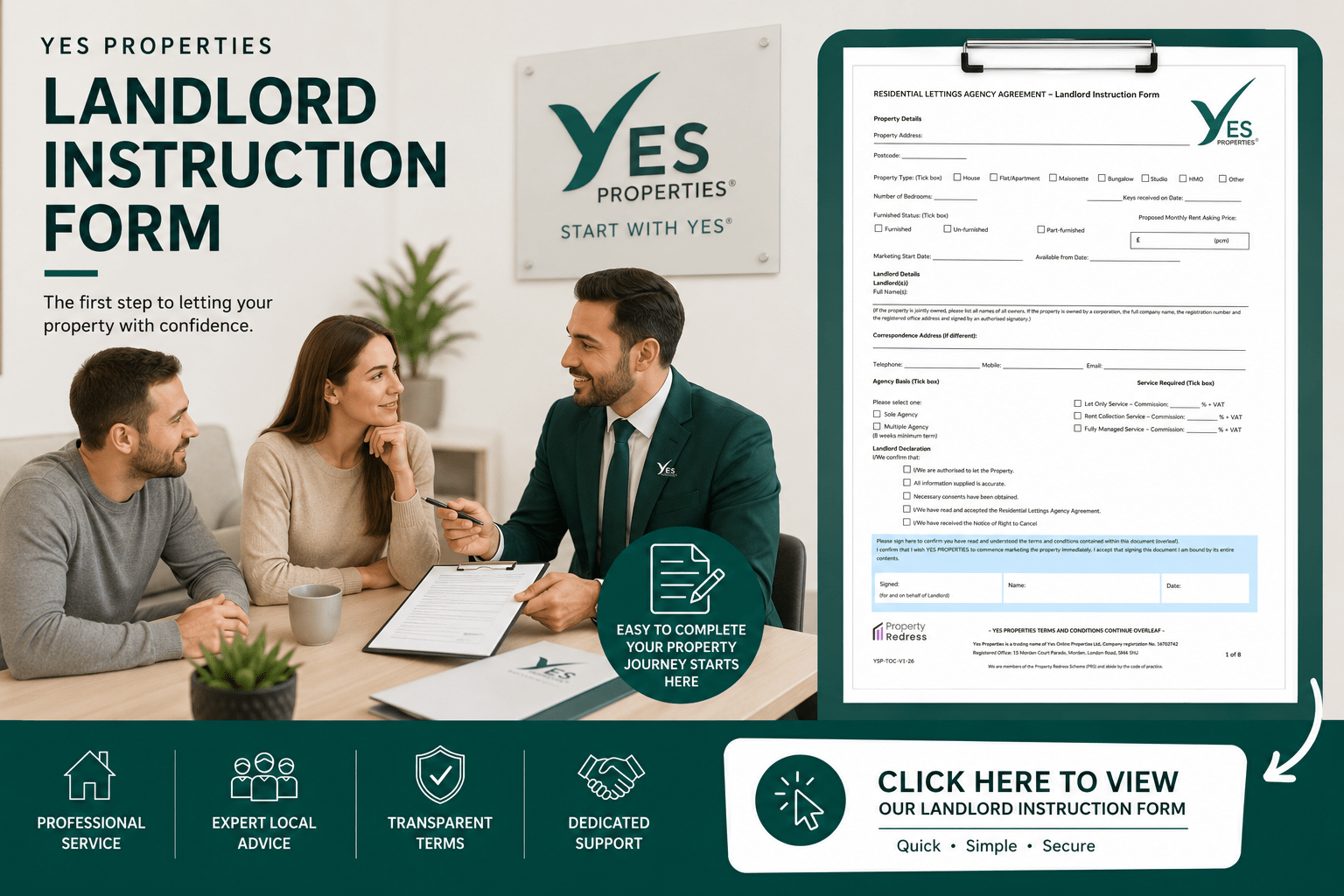
Our Residential Lettings Agreement Explained
A Simple Guide Written in Plain English
We understand that legal agreements can sometimes appear long and complicated. That’s why we’ve created this guide—to explain our Residential Lettings Agency Agreement in straightforward, everyday language.
This guide is designed to help landlords understand how our services work, what responsibilities each party has and what to expect throughout the letting process.
It is not a replacement for our Residential Lettings Agency Agreement. Instead, it explains the agreement using practical examples and illustrations to make it easier to understand. If there is ever a difference between this guide and the signed agreement, the signed agreement will always take precedence.
Whether you’re letting your first property or you’re an experienced landlord, we believe it’s important that you fully understand the services you’ve chosen and the terms you’ve agreed to.
What Is a Residential Lettings Agency Agreement?
A Residential Lettings Agency Agreement is the contract between you (the landlord) and Yes Properties.
It sets out:
- The service you’ve chosen.
- Our responsibilities.
- Your responsibilities.
- How fees are calculated.
- How your property will be marketed.
- How tenants are introduced.
- How your tenancy may be managed.
- What happens if the tenancy is renewed.
- How either party can end the agreement.
Think of it as the instruction manual for our working relationship.
Why Do We Need an Agreement?
Every successful tenancy begins with clear expectations.
The agreement helps protect both you and us by ensuring everyone understands:
✓ What services are included.
✓ What services are optional.
✓ What legal responsibilities remain with the landlord.
✓ What we will do on your behalf.
✓ When fees become payable.
Without a written agreement, misunderstandings can arise much more easily.
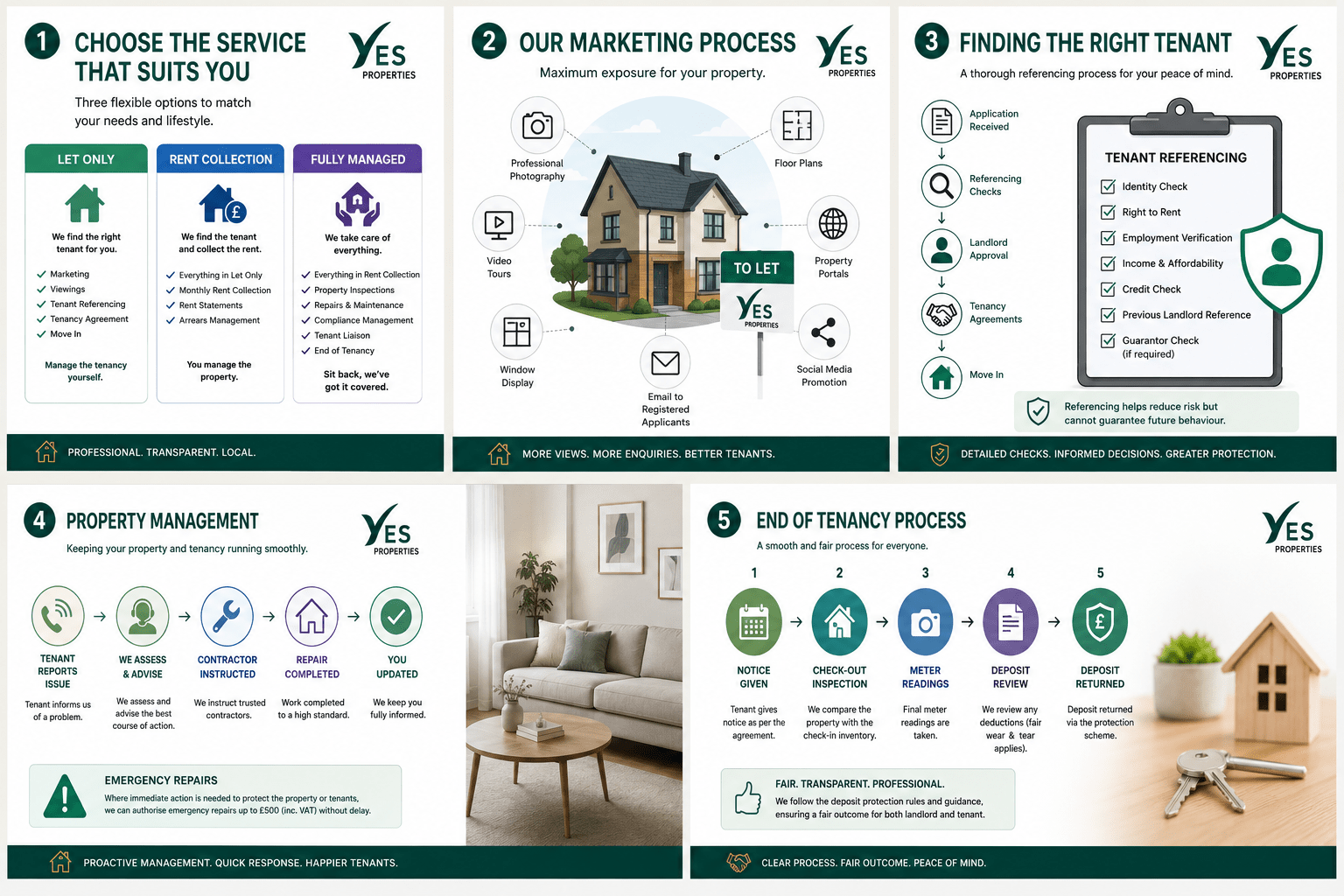
The Lettings Journey
Here’s a simplified overview of how a typical letting progresses.

Each stage is explained in more detail throughout this guide.
Understanding the Landlord Instruction Form
The first page of our agreement is called the Landlord Instruction Form.
This records the key details of your instruction, including:
- Your property address.
- Property type.
- Number of bedrooms.
- Furnished status.
- Asking rent.
- Marketing start date.
- Your contact details.
- The level of service you’ve selected.
- Whether you’ve instructed us on a Sole Agency or Multiple Agency basis.
This ensures both parties have a clear record of what has been agreed before marketing begins.
Choosing Your Service
One of the most important decisions is selecting the level of service that best suits your needs.
Our agreement offers three options:
Let Only
Ideal if you wish to manage the tenancy yourself after a suitable tenant has been found.
We help with:
- Marketing.
- Photography.
- Viewings.
- Tenant referencing.
- Right to Rent checks.
- Preparing the tenancy agreement.
- Move-in administration.
After the tenant moves in, the ongoing management remains your responsibility unless agreed otherwise.
Rent Collection
This service includes everything in Let Only, plus:
- Monthly rent collection.
- Rent statements.
- Basic arrears chasing.
You remain responsible for managing the property itself, but we help administer the financial side of the tenancy.
Fully Managed
Our most comprehensive service.
In addition to the above, we also assist with:
- Routine property inspections.
- Coordinating repairs.
- Liaising with tenants.
- Contractor management.
- Compliance monitoring.
- Deposit administration.
- End-of-tenancy administration.
This option is designed for landlords who would prefer us to handle the day-to-day management of the tenancy on their behalf.
Which Service Is Right for You?
| Let Only | Rent Collection | Fully Managed |
|---|---|---|
| We find the tenant | We find the tenant | We find the tenant |
| You manage the tenancy | We collect the rent | We manage the tenancy |
| You arrange repairs | You arrange repairs | We coordinate repairs |
| You deal with tenant queries | You deal with maintenance | We liaise with tenants |
| Best for experienced landlords | Best for busy landlords | Best for hands-off landlords |
YES Expert Tip: Many first-time landlords choose our Fully Managed Service because it provides ongoing support with compliance, tenant communication and maintenance coordination, helping to reduce the administrative burden of managing a tenancy.
Our Residential Lettings Agreement Explained
Part 2 – Marketing Your Property & Finding the Right Tenant
Once you’ve instructed Yes Properties, the next stage is preparing your property for the market. This is where first impressions count.
Our aim is to present your property professionally, attract the widest possible audience and help secure the most suitable tenant at the best achievable rent.
Our Residential Lettings Agency Agreement authorises us to market your property using a range of methods and to prepare professional marketing materials on your behalf.
Step 1 – Preparing Your Property
Before marketing begins, we’ll normally visit your property to gather all the information required.
This may include:
- Measuring rooms
- Taking professional photographs
- Producing a floor plan
- Preparing the property description
- Confirming key features
- Checking compliance information
- Discussing the asking rent
Think of this stage as preparing your property for its first viewing—except your first viewers will often see it online.
Why Professional Photography Matters
Most tenants begin their search online.
That means your photographs are usually the first impression they’ll have of your property.
Professional images can help:
✔ Generate more enquiries.
✔ Increase viewing requests.
✔ Showcase natural light.
✔ Highlight room sizes.
✔ Present the property at its best.
Poor-quality photographs can discourage otherwise suitable tenants from arranging a viewing.
Example
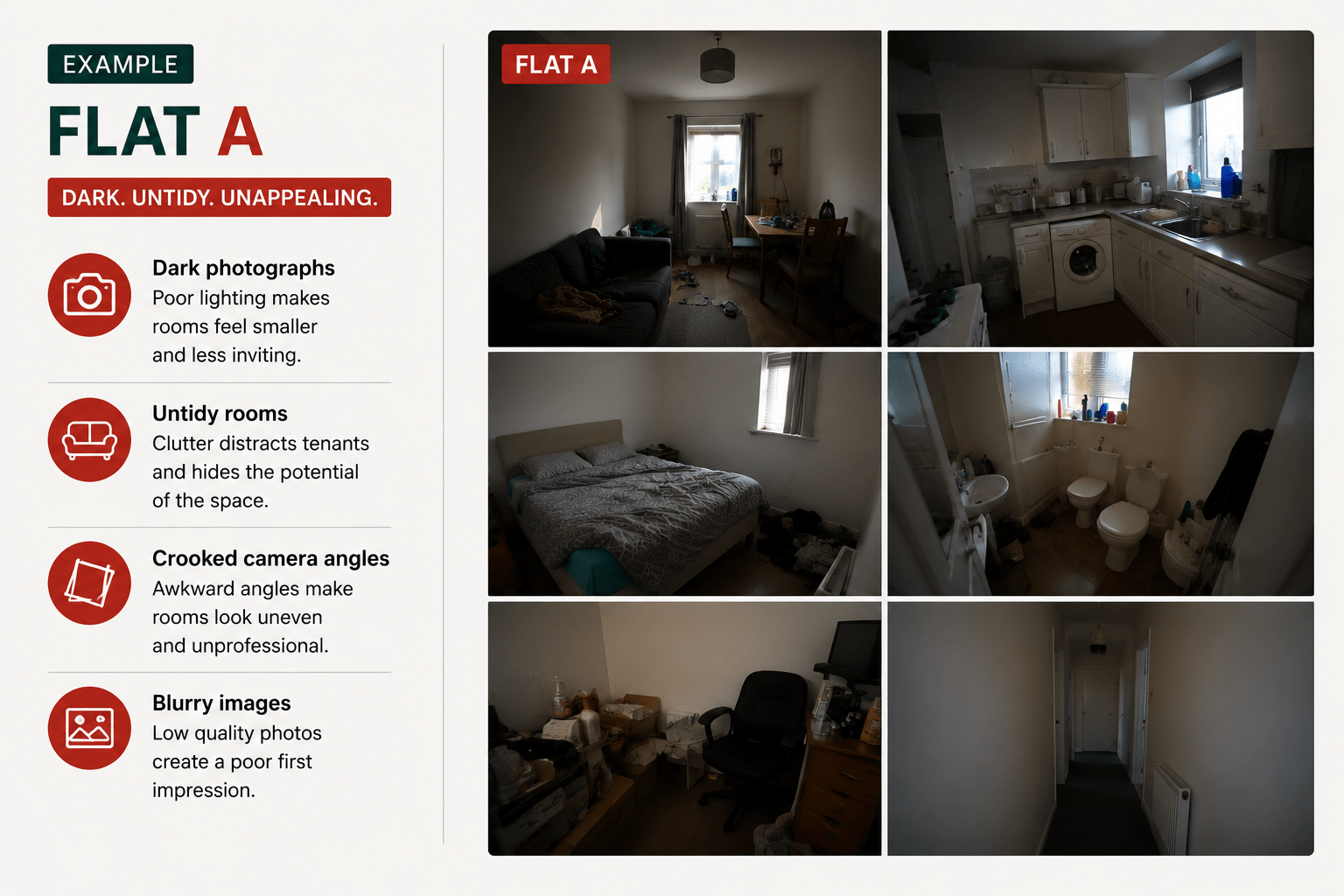
Imagine two identical flats.
Flat A
- Dark photographs.
- Untidy rooms.
- Crooked camera angles.
- Blurry images.
Flat B
- Bright photographs.
- Decluttered rooms.
- Wide-angle professional images.
- Consistent lighting.

Most prospective tenants will naturally click on Flat B first.
Floor Plans
A floor plan helps tenants understand the property’s layout before arranging a viewing.
Rather than simply describing the accommodation, tenants can immediately see:
- Room sizes.
- Room positions.
- Overall flow.
- Storage areas.
- Approximate dimensions.

Many applicants now expect a floor plan as part of a professional property listing.
Property Descriptions
Every property is different.
Our descriptions are written to explain:
- The accommodation.
- Local amenities.
- Transport links.
- Schools (where appropriate).
- Parking.
- Outdoor space.
- Special features.
The aim is to provide accurate, balanced information that helps applicants decide whether the property is suitable for their needs.
Where Will My Property Be Advertised?
Depending on your instruction and marketing strategy, your property may be promoted through:
- The Yes Properties website.
- Major property portals.
- Social media platforms.
- Window displays.
- Email marketing.
- Applicant mailing lists.
- Associated agency networks.
- Printed advertising (where appropriate).
The agreement allows us to determine the most appropriate marketing methods for each property.
Example Marketing Journey

Virtual Tours & Video
Some properties benefit from additional marketing such as:
- Video walkthroughs.
- Virtual tours.
- Drone photography (where appropriate and lawful).
These can help prospective tenants gain a better understanding of the property before arranging a physical viewing.
Not every property requires these services, but they can be particularly useful for premium homes or applicants relocating from further afield.
Property Portals
Many applicants search for rental properties online before contacting an agent.
Advertising through leading property portals allows your property to be seen by a much wider audience than relying solely on local advertising.
This helps maximise exposure during the important first few weeks of marketing.
Social Media Marketing
Where appropriate, we may also promote your property using social media.
This may include:
- Featured property posts.
- Local area promotion.
- Short videos.
- Lifestyle imagery.
- New instruction announcements.
Social media complements traditional property portal advertising by reaching people who may not yet be actively searching.
Viewings
Once enquiries begin arriving, we’ll arrange viewings with suitable applicants.
Our agreement allows us to conduct accompanied viewings where appropriate.
During a viewing we may:
- Introduce the property.
- Explain key features.
- Answer general questions.
- Obtain feedback.
- Assess the applicant’s suitability.
Why Accompanied Viewings?
Accompanied viewings offer several benefits.
They allow us to:
- Present the property professionally.
- Answer questions immediately.
- Gather valuable feedback.
- Help keep the viewing organised.
- Provide reassurance to both landlord and applicant.
Keys & Property Access
Many landlords leave a set of keys with us during the marketing period.
This allows us to:
- Arrange viewings more efficiently.
- Meet contractors if required.
- Provide access for photographers.
- Carry out inspections where instructed.
Keys are stored securely and identified using coded systems rather than property addresses wherever possible.
Only authorised members of our team or approved contractors will be given access when necessary.
Who Owns the Photographs?
This is a question we’re often asked.
Our agreement explains that the copyright in photographs, floor plans, videos and other marketing materials created by or for Yes Properties remains with us, while you grant us permission to use those materials to market your property and promote our business.
What does this mean in practice?
It simply means we can continue to:
- Display sold or let properties in our portfolio.
- Showcase our professional photography.
- Use examples of previous marketing in promotional material.
- Demonstrate the quality of our work.
It does not mean we acquire any ownership rights over your property.
Example
Imagine we produce a beautiful brochure for your home.
After the property has been let, we may wish to include one of the photographs in our website portfolio to demonstrate the standard of our marketing.
This helps future landlords see the quality of presentation we provide.
Frequently Asked Questions
Can I take my own photographs?
You can, but professional photography generally creates a stronger first impression and is more likely to attract enquiries.
Can I stop marketing at any time?
Your rights depend on the type of instruction you’ve signed (for example, Sole Agency or Multiple Agency) and the terms of your agreement. These will be explained in the next section.
Will you accompany every viewing?
Where reasonably practicable, yes. There may occasionally be circumstances where alternative arrangements are agreed, but accompanied viewings are our normal approach.
Can I refuse a viewing?
Yes. As the landlord, you remain in control of access to your property. We will always work with you to arrange suitable viewing times.
YES Expert Tip: The first two weeks of marketing are often the most important. A well-presented property with professional photographs, accurate information and realistic pricing is more likely to attract strong interest and quality applicants early in the marketing period.
Our Residential Lettings Agreement Explained
Part 3 – Finding the Right Tenant & Understanding Tenant Referencing
Finding a tenant is about much more than accepting the first application received. A successful tenancy begins with selecting an applicant who meets the landlord’s requirements and satisfies the necessary referencing and legal checks.
At Yes Properties, our aim is to help landlords make informed decisions by gathering relevant information about prospective tenants. While referencing can significantly reduce risk, it can never guarantee a tenant’s future behaviour or financial circumstances.
This part explains how the tenant selection process works and what you can expect before a tenancy begins.
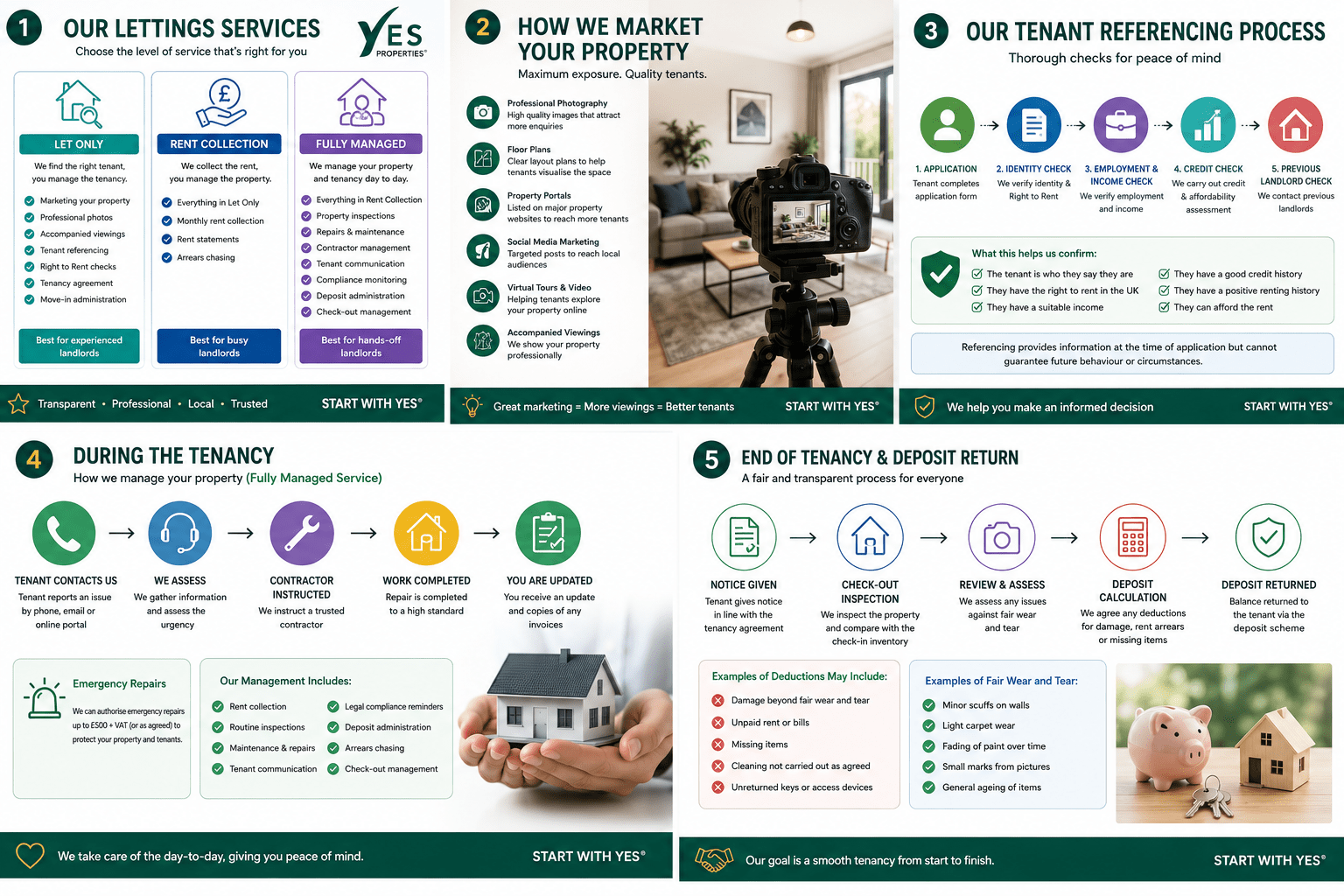
The Tenant Journey
Every tenancy follows a structured process.
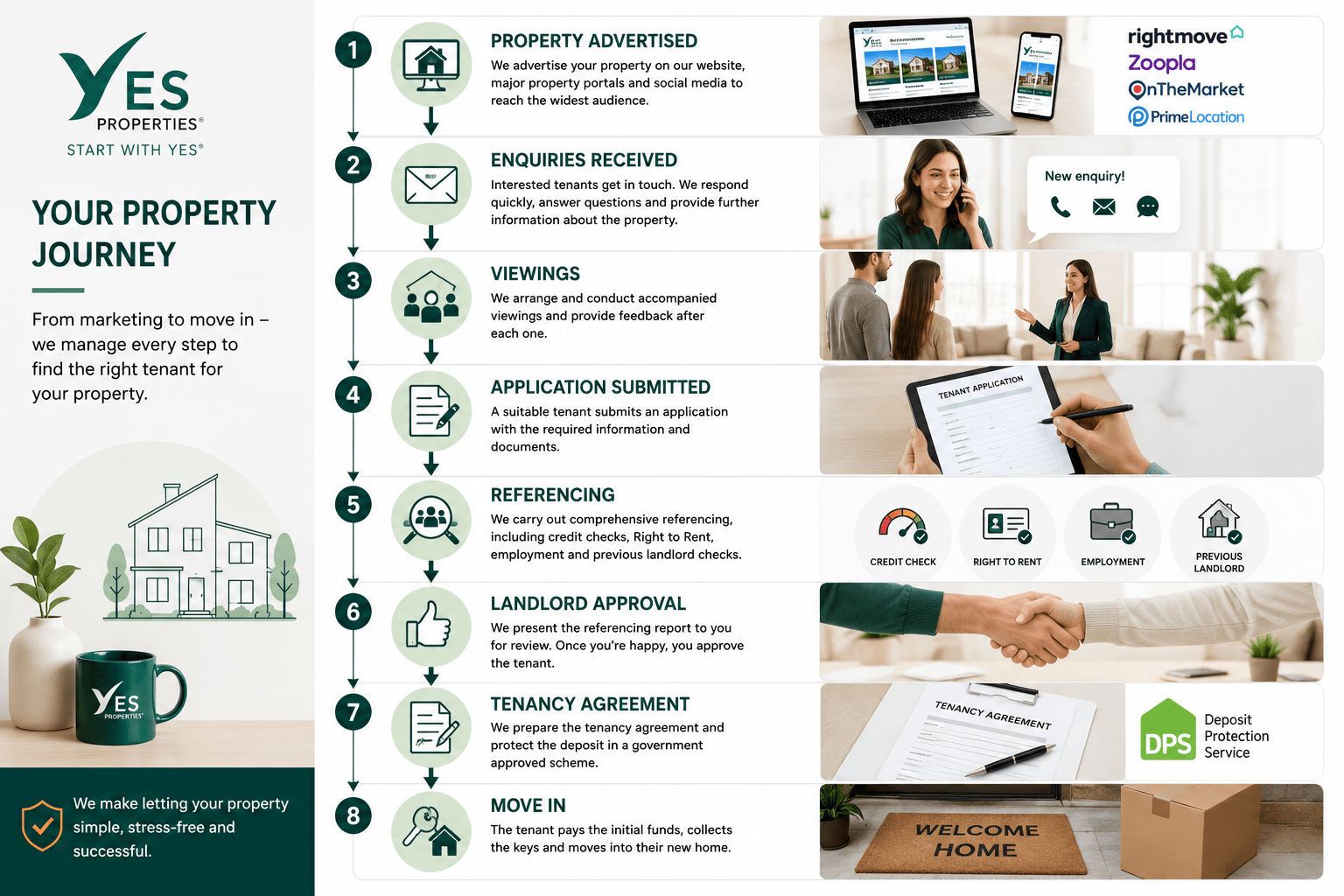
Each stage helps ensure both landlord and tenant are properly prepared before the tenancy commences.
Receiving Tenant Enquiries
Once your property is advertised, prospective tenants will begin making enquiries.
Before arranging a viewing, we may discuss:
- Desired move-in date.
- Number of occupants.
- Employment status.
- Whether they have pets.
- Whether they smoke.
- Whether they require parking.
- Any special requirements.
This helps us determine whether the property is likely to be suitable before progressing further.
Property Viewings
Following an enquiry, suitable applicants are invited to view the property.
During the viewing we may explain:
- The tenancy terms.
- Monthly rent.
- Deposit requirements.
- Included appliances.
- Parking arrangements.
- Local transport.
- Utility arrangements.
- Council Tax band (where known).
- Available move-in dates.
Applicants also have the opportunity to ask questions before deciding whether to proceed.
Making an Application
If an applicant wishes to rent the property, they will normally complete an application form.
Typical information requested includes:
- Full name.
- Current address.
- Contact details.
- Employment information.
- Income.
- Previous landlord details (where applicable).
- Number of occupants.
- Details of any guarantor (if required).
This information forms the basis of the referencing process.
What Is Tenant Referencing?
Tenant referencing is the process of verifying information provided by the applicant before a tenancy is granted.
It helps landlords make informed decisions based on independently verified information.
Our agreement allows us to arrange referencing as part of the letting process where applicable.
What Does Referencing Usually Include?
Depending on the applicant’s circumstances, referencing may include:
- Identity verification.
- Employment verification.
- Income assessment.
- Credit checks.
- Previous landlord reference.
- Affordability assessment.
- Right to Rent checks.
- Guarantor checks (if applicable).
Each application is considered individually.
Employment Verification
Where appropriate, the referencing provider may contact an applicant’s employer to confirm:
- Employment status.
- Job title.
- Length of employment.
- Salary (where disclosed).
This helps establish whether the applicant’s stated employment details can be verified.
Income & Affordability
One of the key considerations is whether the applicant appears able to afford the rent.
Affordability assessments often compare:
- Gross annual income.
- Monthly rent.
- Existing financial commitments.
Different referencing providers and landlords may use different affordability criteria.
Credit Checks
Where included within the referencing process, credit checks may identify information such as:
- County Court Judgments (CCJs).
- Insolvency records.
- Credit history indicators.
- Electoral roll information.
A credit report is only one part of the overall assessment and should be considered alongside the applicant’s wider circumstances.
Previous Landlord References
Where the applicant has rented previously, a reference may be requested from their former landlord or managing agent.
This may include questions about:
- Rent payment history.
- Property care.
- Communication.
- Length of tenancy.
- Whether they would rent to the tenant again.
Previous references can provide useful context but should not be viewed in isolation.
Guarantors
In some situations, a guarantor may be appropriate.
Examples include:
- Students.
- Applicants with limited credit history.
- Applicants changing employment.
- Lower affordability cases.
Where a guarantor is used, they may also be subject to referencing and affordability checks.
Right to Rent Checks
Landlords in England have legal responsibilities to ensure that adult occupiers have the legal right to rent residential property where the law requires.
As part of our service, we can assist with these checks in accordance with current legal requirements.
These checks are an important legal obligation and help ensure compliance with immigration legislation.
Choosing the Right Tenant
After referencing has been completed, we’ll discuss the outcome with you.
As the landlord, the final decision whether to proceed with an applicant remains yours.
When making that decision, you may wish to consider factors such as:
- Referencing outcome.
- Affordability.
- Proposed move-in date.
- Length of intended tenancy.
- Number of occupiers.
- Suitability for the property.
Our role is to present the available information and answer any questions you may have.
Does Referencing Guarantee a Good Tenant?
This is one of the questions we’re asked most often.
The simple answer is no.
Referencing provides valuable information based on the applicant’s circumstances at the time of application. However, it cannot predict future events or behaviour.
For example, a tenant who passes referencing could later experience:
- Job loss.
- Illness.
- Relationship breakdown.
- Financial difficulties.
- Unexpected changes in personal circumstances.
Likewise, an applicant with a less straightforward financial history may go on to become an excellent long-term tenant.
YES Expert Tip: Referencing helps reduce risk—it does not eliminate it. The decision to accept a tenant should always consider the full picture rather than relying on a single factor.
Example 1 – Excellent Applicant
Sarah applies to rent a two-bedroom flat.
Her referencing confirms:
✔ Permanent employment.
✔ Stable income.
✔ Positive previous landlord reference.
✔ Good affordability.
The landlord decides to proceed.
Example 2 – Guarantor Required
Ahmed has recently started a new job.
Although his long-term prospects appear positive, his employment history is limited.
The landlord agrees to proceed provided a suitable guarantor is successfully referenced.
Example 3 – Self-Employed Applicant
James has been self-employed for several years.
Instead of relying solely on payslips, the referencing process may consider:
- Tax returns.
- Accountant’s confirmation.
- Business accounts.
- Bank statements.
Each application is assessed on its own merits.
Frequently Asked Questions
Can I choose between several applicants?
Yes. If multiple suitable applicants express interest, we’ll discuss the options with you so you can make an informed decision.
Can I reject an applicant?
Yes, although any decision should always comply with applicable equality and discrimination laws. We’ll be happy to discuss any concerns you have before a decision is made.
What happens if referencing is unsuccessful?
We’ll explain the outcome and discuss the available options. These may include seeking additional information, considering a guarantor (where appropriate), or continuing to market the property.
Can a tenant move in before referencing is complete?
In most cases, we recommend waiting until all agreed checks have been satisfactorily completed before the tenancy begins.
Common Misunderstandings
Avoid these common assumptions:
– “A good credit score guarantees a good tenant.”
– “A tenant with a guarantor is always high risk.”
– “Referencing predicts the future.”
– “Employment alone guarantees affordability.”
– “Previous renting experience automatically makes someone a better tenant.”
Every application should be considered fairly and on its own individual circumstances.
Our Residential Lettings Agreement Explained
Part 4 – Managing Your Property After the Tenant Moves In
Finding the right tenant is only the beginning of a successful tenancy. Once the tenancy agreement has been signed and the tenant has collected the keys, the focus shifts to managing the property effectively and ensuring both landlord and tenant understand their ongoing responsibilities.
Depending on the service you’ve selected—Let Only, Rent Collection or Fully Managed—our involvement after move-in will vary. This section explains what happens during the tenancy and how we help keep everything running smoothly.
The Tenancy Management Journey
Here’s a simplified overview of what happens after the tenant moves in.
 Each stage is designed to help protect both the landlord and the tenant throughout the tenancy.

The Tenancy Agreement
Before the tenant moves in, both parties sign a tenancy agreement.
This document sets out:
- The rent.
- Payment dates.
- Length of the tenancy.
- Tenant obligations.
- Landlord obligations.
- Rules regarding the property.
- Procedures for ending the tenancy.
The tenancy agreement is separate from your agency agreement with Yes Properties.
Think of it as two separate contracts:
- Agreement 1: Between you and Yes Properties.
- Agreement 2: Between you and your tenant.
Collecting the First Month’s Rent
Before the tenancy begins, the tenant will normally be required to pay:
- The first month’s rent.
- The tenancy deposit (where applicable).
These monies are usually received before the keys are released.
Once cleared, the tenancy can begin.
Protecting the Tenant’s Deposit
Where a tenancy deposit is taken, the law generally requires it to be protected in an authorised tenancy deposit protection scheme within the required timescales.
As part of our services, we can assist with deposit registration and the prescribed information where applicable.
This helps protect both landlord and tenant and ensures compliance with current legislation.
Inventory & Check-In
One of the most important documents created at the start of a tenancy is the inventory.
An inventory records the property’s condition at the beginning of the tenancy.
It may include:
- Photographs.
- Meter readings.
- Furniture.
- Decoration.
- Flooring.
- Appliances.
- Garden condition.
- Keys provided.
This document becomes extremely important if there is any dispute at the end of the tenancy.
YES Expert Tip: A detailed inventory with clear photographs is one of the best ways to protect both landlords and tenants. It provides an objective record of the property’s condition at the start of the tenancy.
Monthly Rent Collection
If you’ve selected our Rent Collection or Fully Managed service, we’ll normally administer the collection of rent on your behalf.
This may include:
- Monitoring rent payments.
- Issuing rent statements.
- Contacting tenants if payment is late.
- Transferring rent to your nominated account after deductions where applicable.
If you’ve chosen our Let Only service, rent collection remains your responsibility after the tenant has moved in.
What Happens if Rent Is Late?
Occasionally, tenants may pay rent later than expected.
If we’re responsible for rent collection, we’ll usually:
- Check whether payment has been received.
- Contact the tenant.
- Discuss the reason for the delay.
- Keep you informed where appropriate.
Persistent arrears may require further action, depending on the circumstances and legal process.
Routine Property Inspections
For landlords using our Fully Managed service, we may carry out periodic property inspections.
These inspections help identify:
- General property condition.
- Maintenance issues.
- Signs of damp.
- Safety concerns.
- Unauthorised alterations.
- Garden condition.
- Early repair requirements.
Following each inspection, we’ll normally provide you with a report summarising our observations and, where appropriate, recommendations.
Repairs & Maintenance
Properties require ongoing maintenance.
Examples include:
- Leaking taps.
- Broken appliances.
- Heating issues.
- Roof leaks.
- Electrical faults.
- Plumbing repairs.
- Garden maintenance.
If you’re using our Fully Managed Service, we’ll coordinate appropriate contractors and keep you informed throughout the process.
Emergency Repairs
Some repairs simply cannot wait.
Examples include:
- Burst water pipes.
- Complete boiler failure during winter.
- Dangerous electrical faults.
- Major water leaks.
- Security issues following a break-in.
Our agreement allows us, in certain circumstances, to authorise emergency repairs up to an agreed financial limit where immediate action is necessary to protect the property or its occupants.
Example
Imagine a boiler fails on a freezing Sunday evening.
Rather than waiting until Monday morning and risking frozen pipes or leaving the tenant without heating, we may arrange an emergency contractor within the authority you’ve given us under the management agreement.
This can help minimise damage and inconvenience.
Landlord Responsibilities
Even when you choose a Fully Managed Service, certain legal responsibilities remain with you as the landlord.
These may include ensuring that:
- Gas Safety Certificates remain valid.
- Electrical safety requirements are met.
- Energy Performance Certificate (EPC) requirements are satisfied.
- Smoke alarms are installed and maintained.
- Carbon monoxide alarms are provided where required.
- The property remains safe and fit for habitation.
- Licensing requirements are complied with where applicable.
We’ll help remind you about many of these obligations, but the legal responsibility ultimately remains with the landlord.
Tenant Responsibilities
Tenants also have responsibilities throughout the tenancy.
These commonly include:
- Paying rent on time.
- Looking after the property.
- Reporting repairs promptly.
- Allowing access for agreed inspections and repairs.
- Not causing damage beyond fair wear and tear.
- Complying with the tenancy agreement.
Good communication between landlord, tenant and managing agent often helps resolve issues before they become more serious.
Communication Throughout the Tenancy
One of the key benefits of a managed service is having a central point of contact.
Rather than the tenant contacting you directly about every issue, we can help coordinate communication relating to:
- Repairs.
- Maintenance.
- Inspections.
- Rent queries.
- Renewal discussions.
- Contractor appointments.
This can save landlords considerable time and reduce day-to-day administration.
Example – A Typical Repair
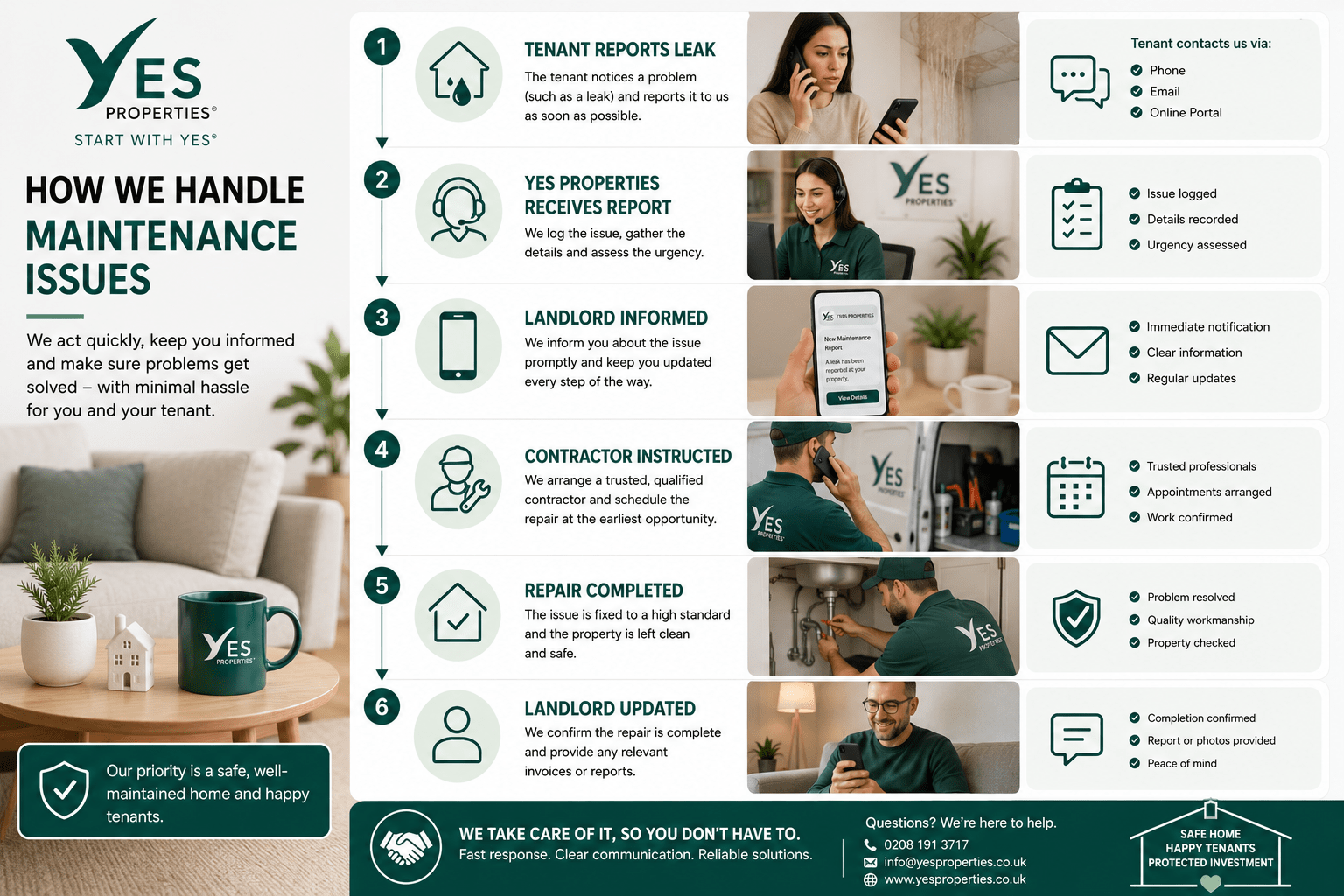
Frequently Asked Questions
Will you arrange repairs without asking me?
For routine repairs, we’ll usually discuss the matter with you first.
However, where you’ve authorised us to deal with emergency situations under the management agreement, immediate action may be taken where necessary to protect the property or comply with legal obligations.
How often are inspections carried out?
Inspection frequency depends on the management service you’ve selected and the circumstances of the tenancy. We’ll agree an appropriate inspection schedule with you.
Can I still speak directly to my tenant?
Yes. However, where you’ve instructed us to provide a Fully Managed Service, allowing us to coordinate communication can help ensure matters are handled consistently and professionally.
Who chooses the contractor?
Where we’re managing the property, we’ll normally arrange suitably qualified contractors. If you have preferred contractors, we’re happy to discuss using them where appropriate.
YES Expert Tip: Preventative maintenance is usually far less expensive than emergency repairs. Addressing small issues promptly can often save significant costs and help keep tenants happy.
Our Residential Lettings Agreement Explained
Part 5 – Renewals, Ending the Agreement & Frequently Asked Questions
By this stage, your tenant has moved into the property and the tenancy is running smoothly. But what happens when the fixed term comes to an end? Can the tenant stay? Can you sell the property? How is the deposit returned?
This final part explains what usually happens at the end of a tenancy, how renewals work, and answers many of the questions landlords ask before signing our agreement.
What Happens When the Fixed Term Ends?
Most tenancies begin with an agreed fixed term, such as 6 or 12 months.
As the end of that term approaches, there are usually several possible outcomes:
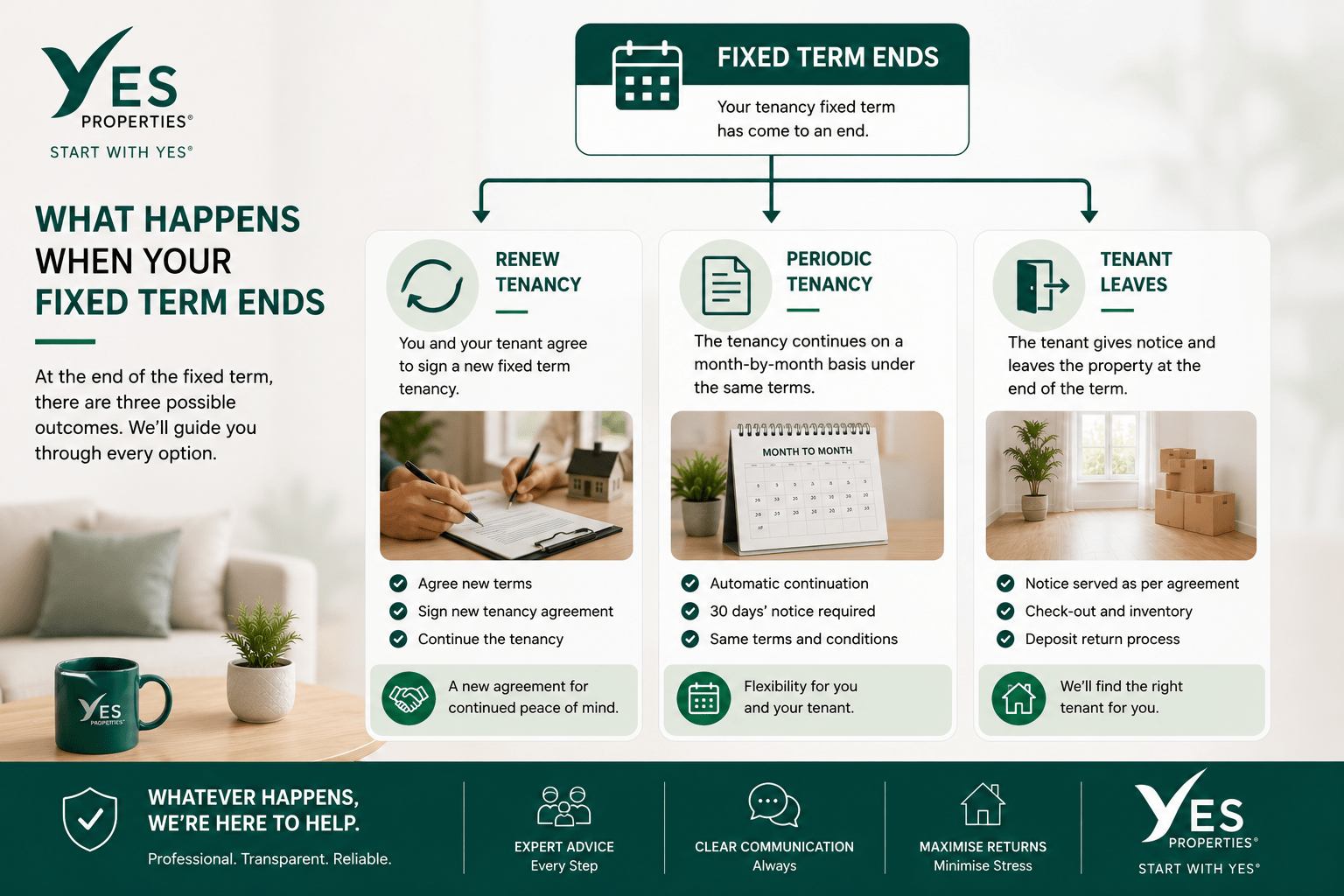
Option 1 – Renew the Tenancy
If both landlord and tenant are happy, a new fixed-term tenancy may be agreed.
Benefits may include:
- Greater certainty.
- Fixed rental income.
- Opportunity to review the rent.
- Updated tenancy documentation where appropriate.
Our agreement explains how renewal arrangements and any applicable fees operate depending on the service selected.
Option 2 – Continue as a Periodic Tenancy
Sometimes neither party signs a new agreement.
Subject to the tenancy terms and the applicable legal framework, the tenancy may continue on a periodic basis.
This provides greater flexibility because the tenancy continues from one rental period to the next unless ended in accordance with the tenancy agreement and the law.
Option 3 – Tenant Moves Out
If the tenant decides to leave, several important steps take place.
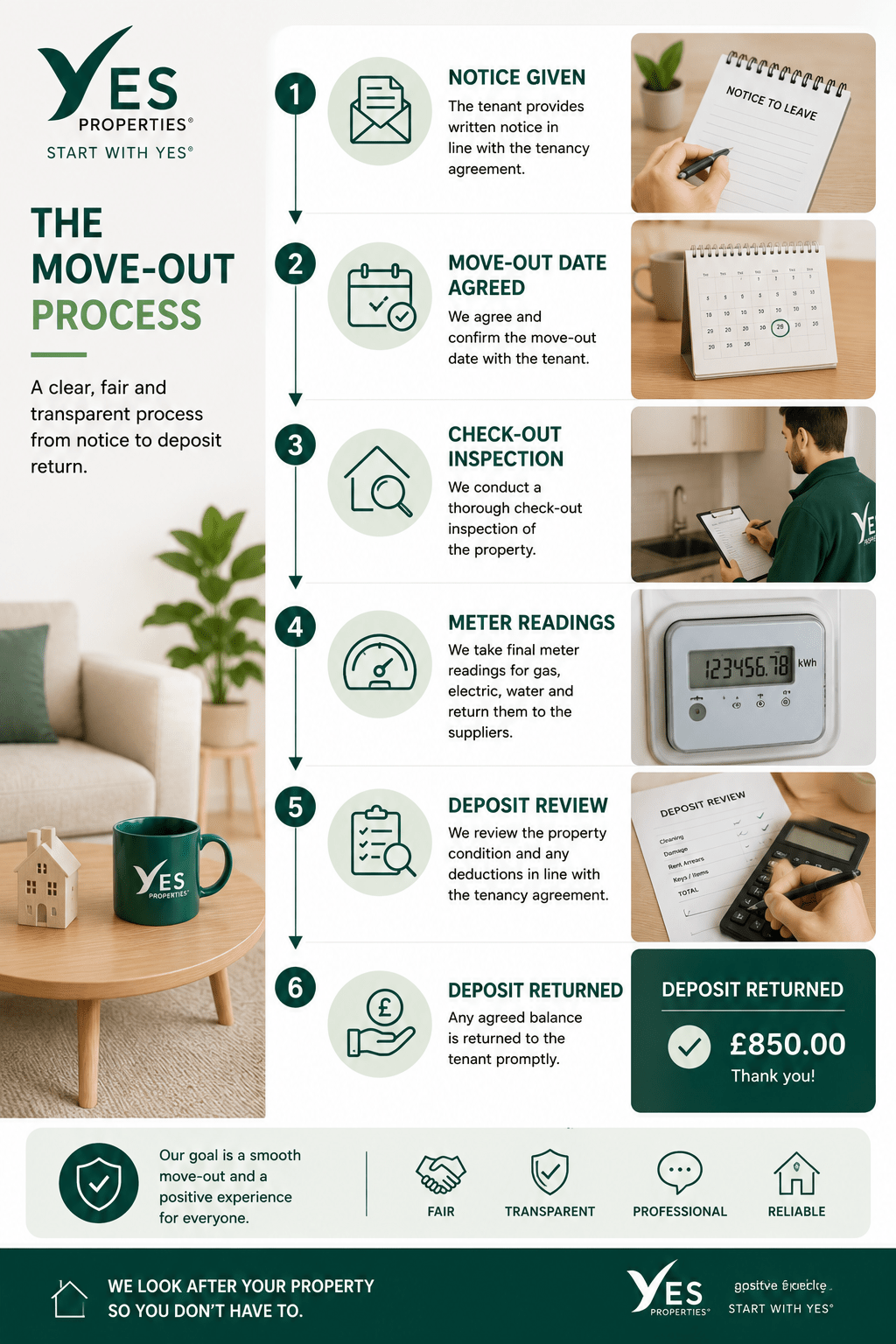
The Check-Out Inspection
A check-out inspection compares the property’s condition with the original inventory prepared at the start of the tenancy.
The inspection may consider:
- Decoration.
- Cleanliness.
- Fixtures and fittings.
- Appliances.
- Gardens.
- Keys returned.
- Meter readings.
The aim is to establish whether the property has been returned in accordance with the tenancy agreement, allowing for fair wear and tear.
Fair Wear and Tear
This is one of the most misunderstood areas of residential lettings.
Properties naturally experience some deterioration through normal everyday use.
Examples of fair wear and tear might include:
– Slight carpet flattening.
– Minor paint fading.
– Small furniture marks.
– General ageing.
Examples that may go beyond fair wear and tear include:
– Large holes in walls.
– Broken internal doors.
– Missing appliances.
– Burn marks.
– Significant damage caused by negligence.
Each tenancy is assessed individually, taking into account the age and condition of the property at the start of the tenancy.
Deposit Deductions
If deductions are proposed, they should normally relate to matters supported by evidence, such as:
- Damage beyond fair wear and tear.
- Outstanding rent.
- Missing items.
- Cleaning where required under the tenancy agreement.
- Unreturned keys.
Where a tenancy deposit has been protected in an authorised scheme, any disagreement about deductions may be dealt with through that scheme’s dispute resolution process.
Selling During a Tenancy
Many landlords ask:
“Can I sell my property while it is let?”
Yes, although the tenant’s legal rights must be respected.
Depending on the circumstances, the property may be:
- Sold with the tenant in occupation.
- Sold after the tenancy has ended.
We’ll be happy to discuss the options if your plans change during the tenancy.
What Happens if My Tenant Wants to Stay Longer?
If your tenant has looked after the property and paid rent on time, continuing the tenancy may be beneficial for both parties.
We’ll discuss:
- Renewal options.
- Rent review (where appropriate).
- Updated tenancy documentation.
- Future plans.
Good tenants are valuable, and many landlords choose to retain them where possible.
Can I Change Service During the Tenancy?
Yes, in many cases.
For example:
- You may initially choose Let Only.
- Later decide you’d like Rent Collection.
- Eventually upgrade to Fully Managed.
If your circumstances change, we’ll be happy to discuss the services available.
When Does Our Agency Agreement End?
Our Residential Lettings Agency Agreement explains how either party may bring the agency relationship to an end, together with any notice requirements and any continuing rights that may apply where a tenant introduced through our agency remains in occupation or enters into a renewal, depending on the service selected.
If you’re ever unsure how these provisions apply to your situation, we’ll happily explain them before you sign.
Frequently Asked Questions
Can I find my own tenant?
Depending on the type of instruction you’ve given us (for example, Sole Agency or Multiple Agency), introducing your own tenant may have implications under the agreement. We’ll explain these arrangements clearly before marketing begins.
Can I cancel the agreement?
Yes, subject to the terms of the agreement and any applicable legal rights. We’ll always explain the relevant notice periods and cancellation provisions before you instruct us.
Who owns the marketing photographs?
Professional photographs, floor plans and other marketing materials produced by or for Yes Properties remain our intellectual property, although they are created to market your property effectively.
What if my tenant stops paying rent?
We’ll discuss the available options with you based on the service you’ve chosen. This may include contacting the tenant, discussing repayment arrangements, and advising on the next appropriate steps where necessary.
Can I visit my property whenever I want?
While you remain the property owner, tenants are entitled to the quiet enjoyment of their home. Access should normally be arranged in advance and in accordance with the tenancy agreement and legal requirements.
Will you remind me about legal certificates?
Where you’re using our Fully Managed Service, we’ll help monitor important compliance dates and remind you when certificates such as Gas Safety Records, EICRs and EPCs are approaching renewal. However, the legal responsibility for compliance remains with the landlord.
Common Misunderstandings
Let’s clear up a few common misconceptions.
– “Fully Managed means I have no legal responsibilities.”
Not quite.
While we can assist with day-to-day management, landlords remain legally responsible for many statutory obligations.
– “Tenant referencing guarantees the tenant.”
No.
Referencing helps reduce risk by providing information at the time of application, but it cannot predict future events or behaviour.
– “Property management means I never hear from the tenant.”
Often we’ll be the first point of contact, but there may still be occasions when your input or decision is needed.
– “Repairs always need my approval.”
Routine repairs are normally discussed with you first. However, where you’ve authorised us under the agreement, emergency works may be arranged to protect the property or comply with legal obligations.
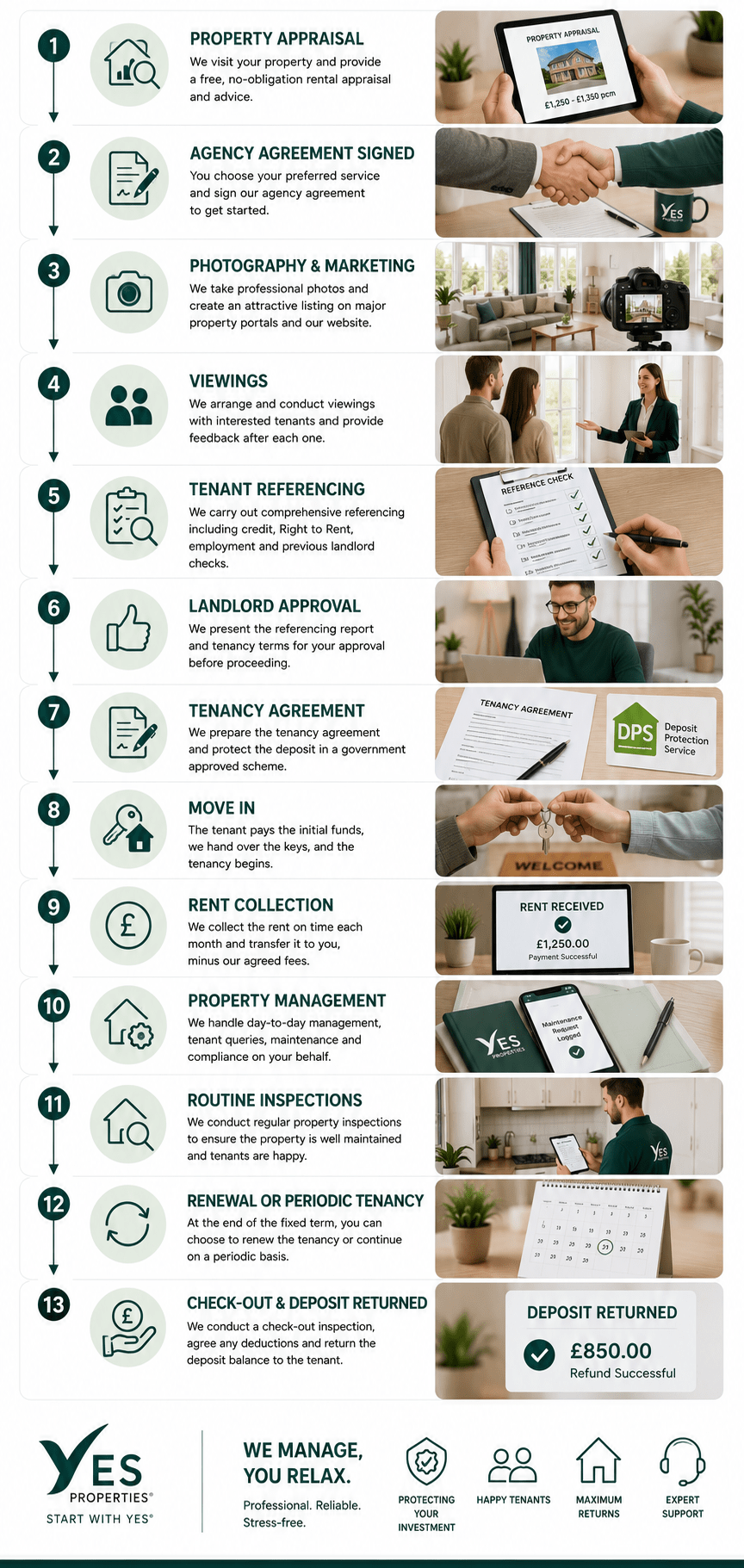
Your Complete Lettings Journey
Why Choose Yes Properties?
Choosing a letting agent is about more than simply finding a tenant. It’s about working with a team that understands legislation, communicates clearly and supports you throughout the tenancy.
At Yes Properties, we pride ourselves on being transparent from the very beginning. That’s why we’ve created this plain-English guide—to help you understand exactly how our Residential Lettings Agency Agreement works before you sign it.
Whether you’re a first-time landlord or have an established portfolio, we’re committed to providing:
- Clear and honest advice.
- Professional marketing.
- Thorough tenant referencing.
- Efficient tenancy administration.
- Ongoing property management.
- Compliance guidance.
- Prompt communication.
- Dedicated support throughout the tenancy.
Our aim is to build long-term relationships based on trust, professionalism and exceptional service.
START WITH YES®
Have questions about our Lettings Agreement or our services?
We’re always happy to explain anything that isn’t clear before you sign.
Yes Properties
15 Morden Court Parade
London Road
Morden
SM4 5HJ
Telephone: 0208 191 3717
Email: info@yesproperties.co.uk
Website: www.yesproperties.co.uk
Professional. Transparent. Local.
START WITH YES®
Related Guides
You may also find these guides helpful:
- Our Residential Sales Agreement Explained
- Landlord Compliance Guide
- EPC
- Understanding Tenancy Deposits
- Gas Safety Explained
- Electrical Safety for Landlords
- Right to Rent Explained
- Property Management vs Let Only
- Rent Collection Service Explained
- First-Time Landlord Guide
Conclusion
A lettings agreement should never feel intimidating. While legal contracts naturally contain formal language, their purpose is simply to establish clear expectations and protect everyone involved.
We hope this guide has helped explain how our Residential Lettings Agency Agreement works in a practical, easy-to-understand way. By combining plain English, real-life examples and visual explanations, we’ve aimed to make the process as transparent as possible.
If you have any questions about any clause in our agreement, our team will always be happy to explain it before you sign. We believe that informed landlords make confident decisions, and we’re here to support you every step of the way.
START WITH YES®